What temperature should you set in winter?
There's no magic number, and anyone who tells you there is hasn't met your household. The U.S. Department of Energy's Energy Saver guidance suggests around 68°F while you're awake and home, and lower while you're asleep or away. That's a reasonable starting point. A home with a newborn, an elderly parent or someone who's ill may need it warmer, and that's fine. Comfort and health come first.
What actually moves your bill is how many hours the house sits at the higher setting and how far you drop it the rest of the time. A house held at 70°F around the clock uses more heat than one that drops to the low 60s overnight, even if the daytime setting is the same.
Pick the lowest setting that feels comfortable in a sweater, then live with it for a week before deciding. Most people adjust faster than they expect.
Does turning the heat down at night really save money?
Yes, for most homes with a gas furnace. The Department of Energy says you can save as much as 10% a year on heating and cooling by turning the thermostat back 7 to 10 degrees for 8 hours a day. It also notes that the savings percentage tends to be larger in milder climates.
That second point matters in Solano County. NOAA's 1991–2020 climate normals put the heating load here at roughly 2,100 to 2,450 heating degree days a year depending on the station: about 2,093 in Vallejo, 2,149 in downtown Vacaville, 2,307 in Fairfield and 2,446 at Nut Tree Airport. That's light compared with most of the country. Average January lows sit around 40°F in Fairfield and Vacaville and 42°F in Vallejo. In a climate like that, the house loses heat slowly overnight, so a setback saves a bigger share of a smaller bill.
The old myth that "the furnace works harder to reheat the house, so you save nothing" doesn't hold up for a gas furnace. A house loses heat faster when it's warm inside than when it's cool, so letting it cool overnight means less total heat lost. The morning warm-up doesn't cancel that out.
A simple winter schedule for a gas furnace
About 6 in 10 homes in Fairfield, Vacaville, Suisun City, Benicia, Dixon and Vallejo heat with natural gas, according to U.S. Census ACS data, so this is the setup most households have. A starting schedule:
| Time | Setting idea | Why |
|---|---|---|
| Wake-up (start warming about 30 minutes before) | Your comfort temp, around 68°F | Warm house when you get up |
| Everyone out for the day | 7 to 10 degrees lower | No reason to heat an empty house |
| Evening at home | Comfort temp | Back to normal before you arrive |
| Bedtime to wake-up | 7 to 10 degrees lower | Most people sleep fine cooler with good bedding |
| Away a few days | Low setting, not off | Keeps the house from getting damp and cold |
Fan on Auto, not On. With the fan on On, the blower keeps running between heating cycles and pushes room-temperature air around, which feels drafty and runs up electricity use. The exception is wildfire smoke or allergy season, when running the fan through a good filter can be worth it (see wildfire smoke and HVAC).
If you work from home, skip the daytime setback and lean harder on the overnight one. One deep setback beats several fiddly ones you'll override.
Why heat pumps need a different approach
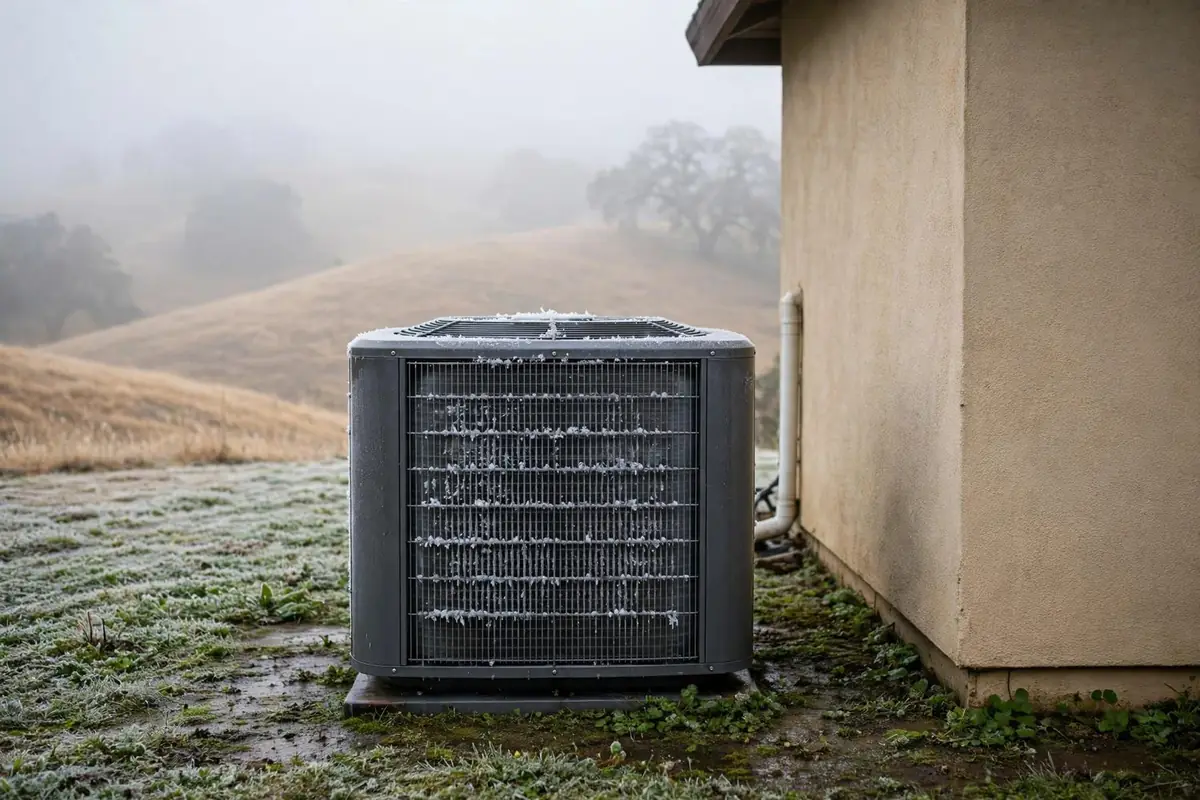
About a third of homes here heat with electricity, and a growing number of those are heat pumps. Heat pumps are efficient, but they warm the house slowly. When you ask one to climb 8 or 10 degrees at 6 a.m., many systems call in their electric backup heat (heat strips) to get there faster. Backup strips are much more expensive to run than the heat pump itself.
The Department of Energy's guidance has long said programmable setbacks aren't generally a good fit for heat pumps, and that a steady moderate setting is usually the most cost-effective approach. Newer thermostats designed for heat pumps soften that rule. Many have adaptive or smart recovery that starts warming early and slowly so the backup heat stays off.
A practical approach for most heat pump homes:
- Use a small overnight setback, a few degrees at most, or none.
- Make sure your thermostat is set up for a heat pump and has smart recovery turned on, if it offers it.
- Watch the display. If you see "Aux heat" or "Auxiliary" lit up every morning, your setback is probably too big.
- Don't switch to "Emergency heat" unless the heat pump has actually failed. It runs backup heat only.
For the full explanation of those two modes, see aux heat vs emergency heat. For thermostat choices, see smart thermostats with heat pumps and furnaces.
How do PG&E time-of-use rates change winter settings?
Many PG&E residential customers are now on a time-of-use electric plan, where electricity costs more during peak hours. On PG&E's common E-TOU-C plan, the peak runs from 4 to 9 p.m. every day. Other plans have different windows, so check your bill or your PG&E account for the plan name before planning around it.
What that means depends on how you heat:
- Gas furnace. Gas isn't billed by time of day, so TOU barely touches your heating cost. The blower motor uses some electricity, but your schedule should be built around comfort and the gas bill, not peak hours.
- Heat pump. Now it matters. Heating during 4 to 9 p.m. costs more per hour. Many owners warm the house a degree or two above normal in the early afternoon, then let it coast down slowly through the peak. A tight, well-insulated house coasts longer.
- Electric wall or baseboard heat. Same idea as a heat pump, but these heaters can't pre-heat as efficiently. Heat the rooms you're using, not the whole house.
Customers in Fairfield, Benicia, Vallejo and unincorporated Solano County are enrolled in MCE for electric generation by default, according to MCE's service area page. PG&E still delivers the power and sends the bill. Your rate plan and its time periods still show on that bill. For the summer side of TOU, see PG&E time-of-use and your AC.
Settings to avoid
A few habits cost money or cause problems without much benefit:
- Cranking the thermostat to 80°F to "heat faster." Furnaces and heat pumps deliver heat at the same rate no matter how high you set it. It just overshoots.
- Turning the system off completely for a week away in January. Usually not dangerous in this climate, but the house gets cold and damp, and the recovery is long. A low setting is better.
- Closing vents in unused rooms to save energy. With most duct systems this raises duct pressure and can make the system less efficient. If one room is always cold or hot, see why one room is always cold.
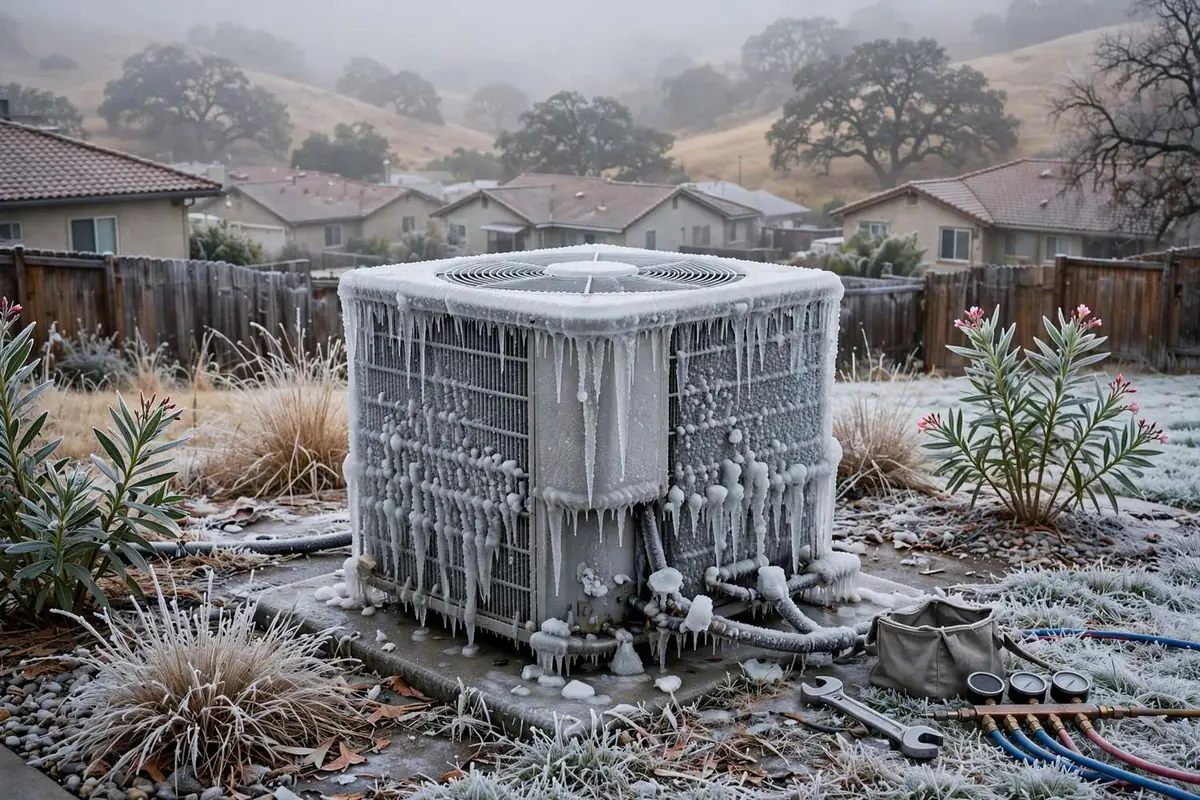
- Leaving a heat pump on emergency heat for days because the outdoor unit iced over once. Ice and defrost cycles are normal. See heat pump not heating.
- Putting a lamp, TV or space heater near the thermostat. It reads the extra warmth and shuts the heat off too early.
What about humidity, pets and older relatives?
Winter air indoors can feel dry, especially with a gas furnace running a lot on cold, clear nights in Vacaville or Dixon. If the air feels dry at 68°F, a humidifier may let you stay comfortable at a lower setting. Marsh-side homes near Suisun City tend to have the opposite issue, with damp air that feels colder than the number on the thermostat.
Pets are generally fine with normal setbacks, but small, old or short-haired animals may need a warm spot. Older adults and babies are more sensitive to cold. For them, skip deep overnight setbacks in the rooms they sleep in.
If you're using a space heater while the furnace is down, see space heater safety.
Quick checklist for the first cold week
- Thermostat set to Heat, fan on Auto.
- Schedule set, with the clock and day correct (power outages can reset some models).
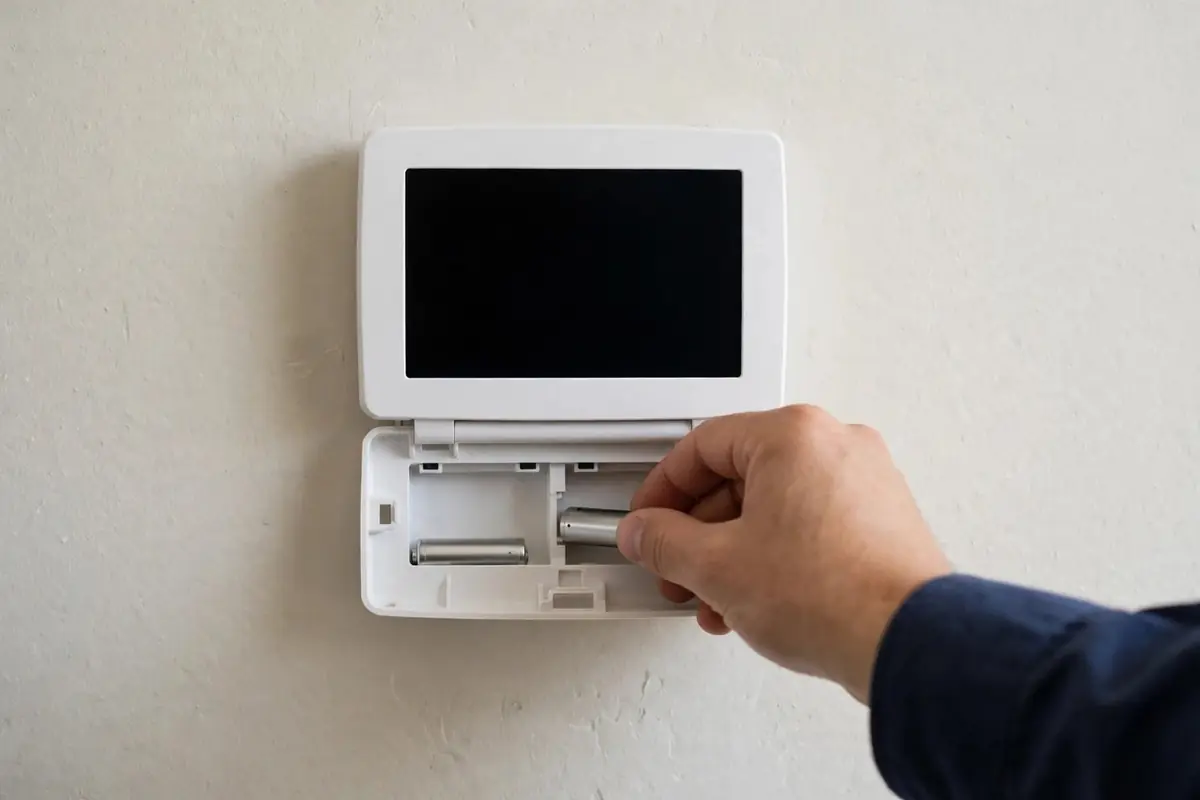
- Batteries replaced if your thermostat uses them. A blank screen is often just dead batteries; see thermostat blank.
- Heat pump owners: setback kept small, smart recovery on, and aux heat not running every morning.
- Filter checked and replaced if it's dirty.
- Furnace power switch and breaker on.
- Carbon monoxide alarms tested.
The fall furnace checklist has the full startup routine.
When the settings aren't the problem
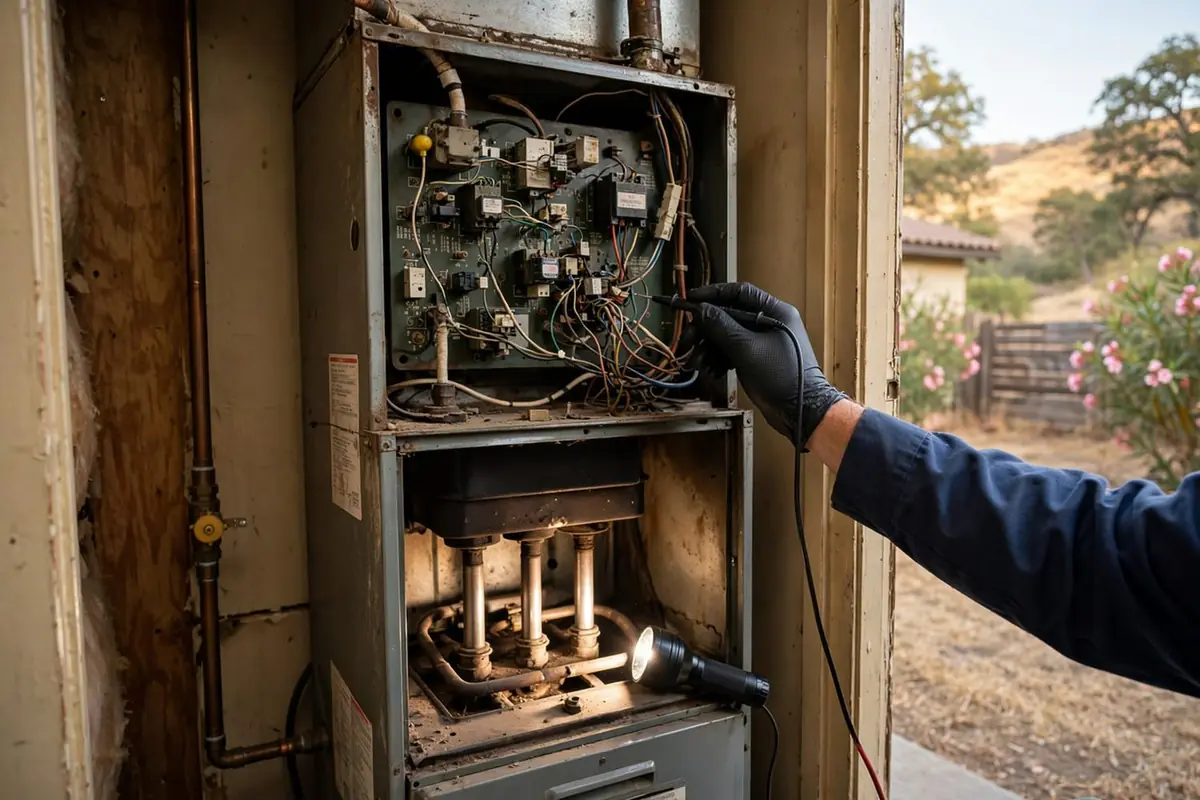
If the house can't reach the setpoint, the heat runs constantly, the furnace turns on and off every few minutes, or the vents blow cool air, the thermostat schedule isn't the issue. Something in the system needs attention. See furnace short cycling or furnace blowing cold air for step-by-step checks.
RD Heat & Air is a referral line for Fairfield, Vacaville, Suisun City, Benicia, Dixon and Vallejo. Calling (707) 418-4772 connects you with a participating local heating company. Tell them what the thermostat is set to, what the house actually reaches, and whether you have a gas furnace or a heat pump.
Sources
- NOAA NCEI, U.S. Climate Normals 1991–2020 (station files for Vacaville, Nut Tree Airport, Fairfield, Vallejo)
- U.S. Census Bureau, American Community Survey 2020–2024 5-year (tables B25003, B25035, B25040), via Census Reporter
- MCE, Service area
Last reviewed 2026-11-12 by the RD Heat & Air editorial team. Editorial policy.