No heat at all: furnace won't turn on
When nothing happens at all (no blower, no clicking, no flame), the problem is usually power or control, not the burner.
- Thermostat on Heat, set at least 3°F above room temperature. Blank screen: replace the batteries.
- The furnace service switch (it looks like a light switch on or near the furnace) is on.
- No tripped breaker labeled furnace or FAU. Reset once only.
- The furnace door is fully closed. A safety switch behind the door cuts power if it's loose.
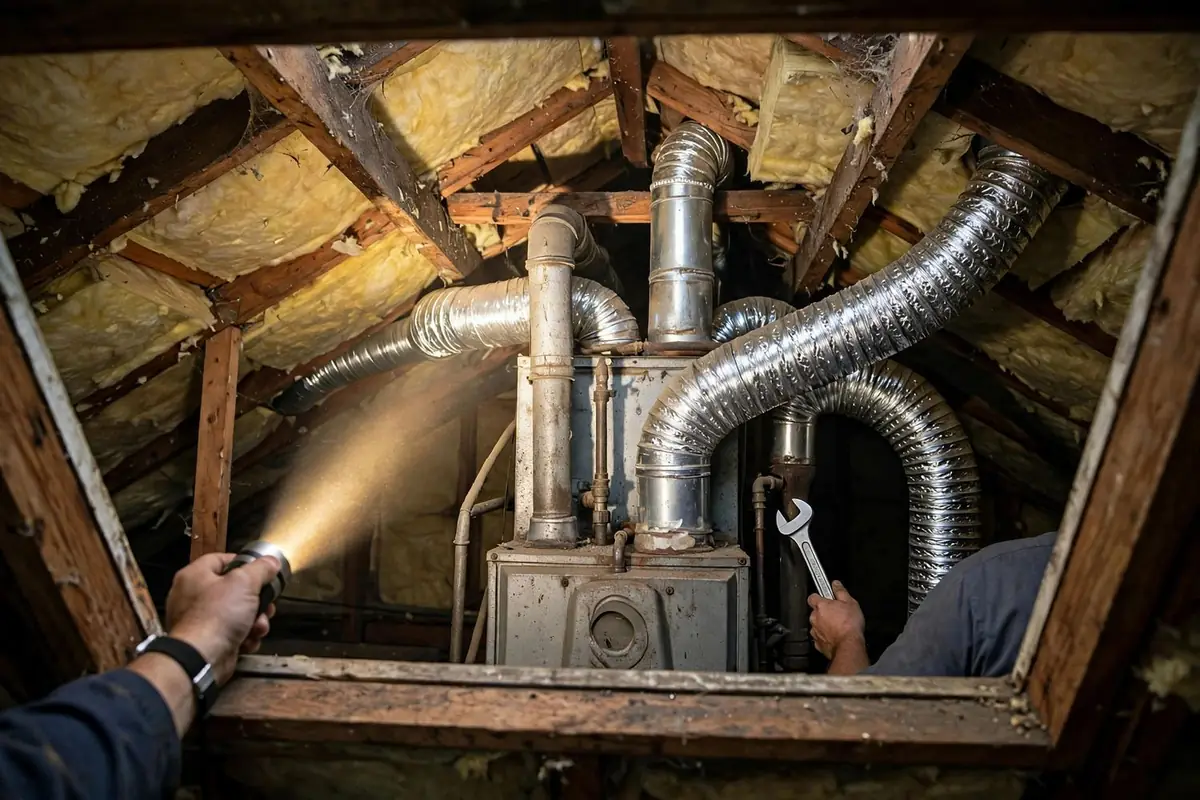
- Attic or closet furnaces: check the condensate overflow switch if your system has one. Water in the pan shuts it off.
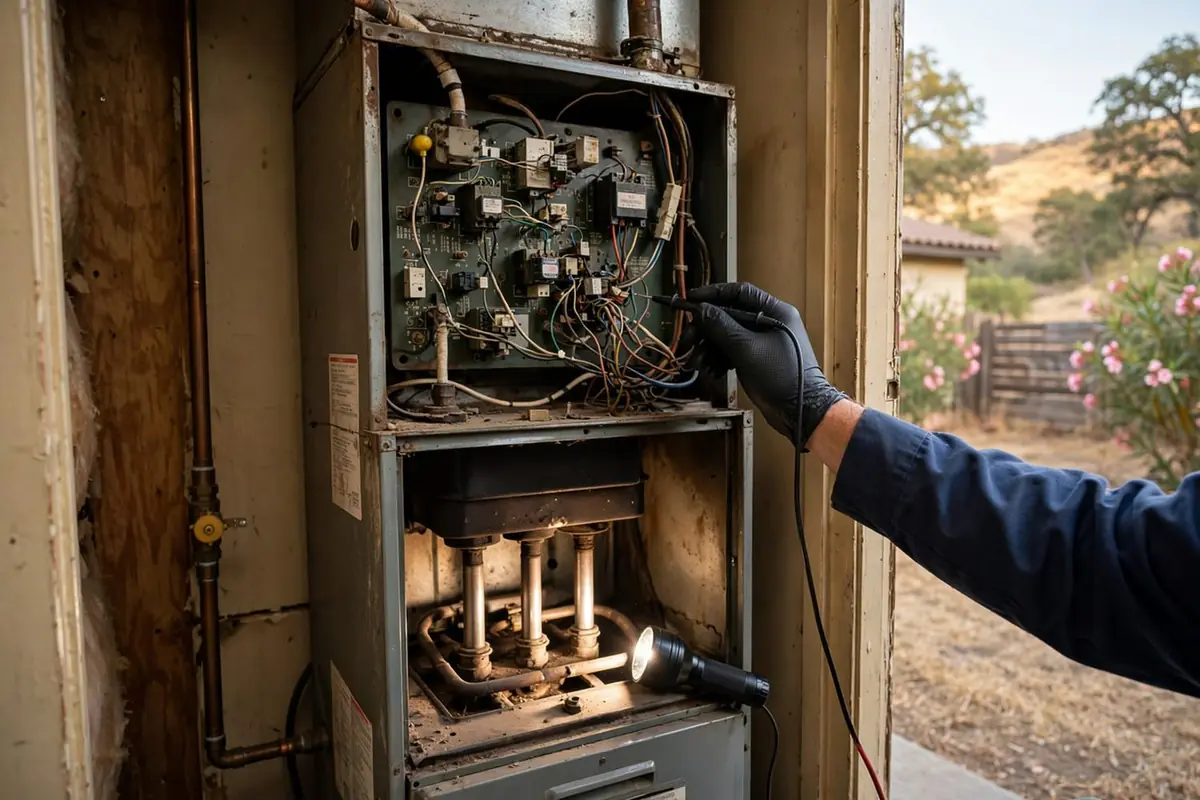
If the furnace still does nothing, a technician will typically test the 24-volt control circuit, transformer, door switch, fuse on the control board and the board itself.
Furnace blowing cold air
Cold air from the vents usually means the blower is running but the burners aren't staying lit. On modern furnaces the sequence is: inducer fan, pressure switch closes, igniter glows, gas valve opens, flame sensor proves the flame. A failure at any step means no heat while the fan still runs.
- Dirty flame sensor: the burners light for a few seconds, then shut off. Very common after a summer of sitting idle.
- Failed hot surface igniter: you hear the inducer fan but never see the glow or flame.
- Thermostat set to "Fan On": the blower runs constantly, pushing room-temperature air between heat cycles. Set it to Auto.
- Overheating from a clogged filter: the high-limit switch shuts the burners off to protect the heat exchanger.
If it's a heat pump rather than a gas furnace, see the heat pump guide. Cold air in heat mode has different causes there.
Furnace turns on and off (short cycling)
A furnace that starts, runs a minute or two, then stops is protecting itself. The common causes are a clogged filter tripping the limit switch, a dirty flame sensor, closed or blocked supply vents, a thermostat placed near a heat source, or an oversized furnace. Replace the filter and open all registers first. If it keeps cycling, a technician will check the limit switch, temperature rise across the heat exchanger and flame signal.
Clicking, booming or a burning smell
- Repeated clicking with no flame: the ignition sequence is failing. Turn the furnace off after three tries and call.
- A boom when the burners light: delayed ignition, often dirty burners. Stop using the furnace and have it checked.
- A dusty burning smell on the first cold night: normal for the first several minutes as dust burns off the heat exchanger. If it lasts or smells electrical, shut it off.
- Rotten-egg smell: treat it as a gas leak. Leave the house and call 9-1-1 and PG&E at 1-800-743-5000 from outside.
Why Solano County furnaces fail on the first cold night
Winters here are mild. January lows average around 40°F in Fairfield and Vacaville (NOAA normals). So furnaces often sit unused from March to November. Dust settles on flame sensors, filters get forgotten, and the first real cold snap is when weak igniters and sensors finally fail. A quick fall start-up with a fresh filter, before the first cold front, catches most of these problems early.
Most homes in the area are 1980s builds (median year built: Fairfield 1986, Vacaville 1985, Suisun City 1984), so many furnaces are second or third replacements sitting on original attic ductwork. Leaky or crushed ducts can make a working furnace feel weak.
What the technician will usually check
- Thermostat call for heat and low-voltage controls.
- Ignition sequence: inducer motor, pressure switch, igniter, gas valve, flame signal.
- Burners, flame pattern and venting.
- Heat exchanger condition and combustion safety.
- Blower motor, capacitor and airflow.
- Filter, return air and temperature rise.
Ask for the diagnosis and a written price before repair work starts.
What affects the price of a furnace repair
- The part: a flame sensor cleaning or igniter is a small job; a blower motor, inducer or control board is more; a cracked heat exchanger usually means replacement.
- Access: attic installs take longer than garage or closet units.
- Timing: after-hours and weekend calls often cost more.
- Age: parts for older furnaces can take longer to source.
See paying for repairs for financing and program options.
Troubleshoot a specific furnace problem
- Furnace not turning on: power, switch, breaker and door checks
- Furnace blowing cold air: six causes, from fan settings to flame sensors
- Furnace short cycling: filters, limit switches and sizing
- Burning or gas smell: which smells are normal and which mean leave now
- Thermostat blank: batteries, power and float switches
- Fall furnace checklist: ten minutes in October
Sources
- NOAA NCEI, U.S. Climate Normals 1991–2020 (station files for Vacaville, Nut Tree Airport, Fairfield, Vallejo)
- U.S. Census Bureau, American Community Survey 2020–2024 5-year (tables B25003, B25035, B25040), via Census Reporter
- PG&E, Gas safety and emergencies
- Contractors State License Board, C-20 Warm-Air Heating, Ventilating and Air-Conditioning classification
Last reviewed 2026-11-12 by the RD Heat & Air editorial team. Editorial policy.