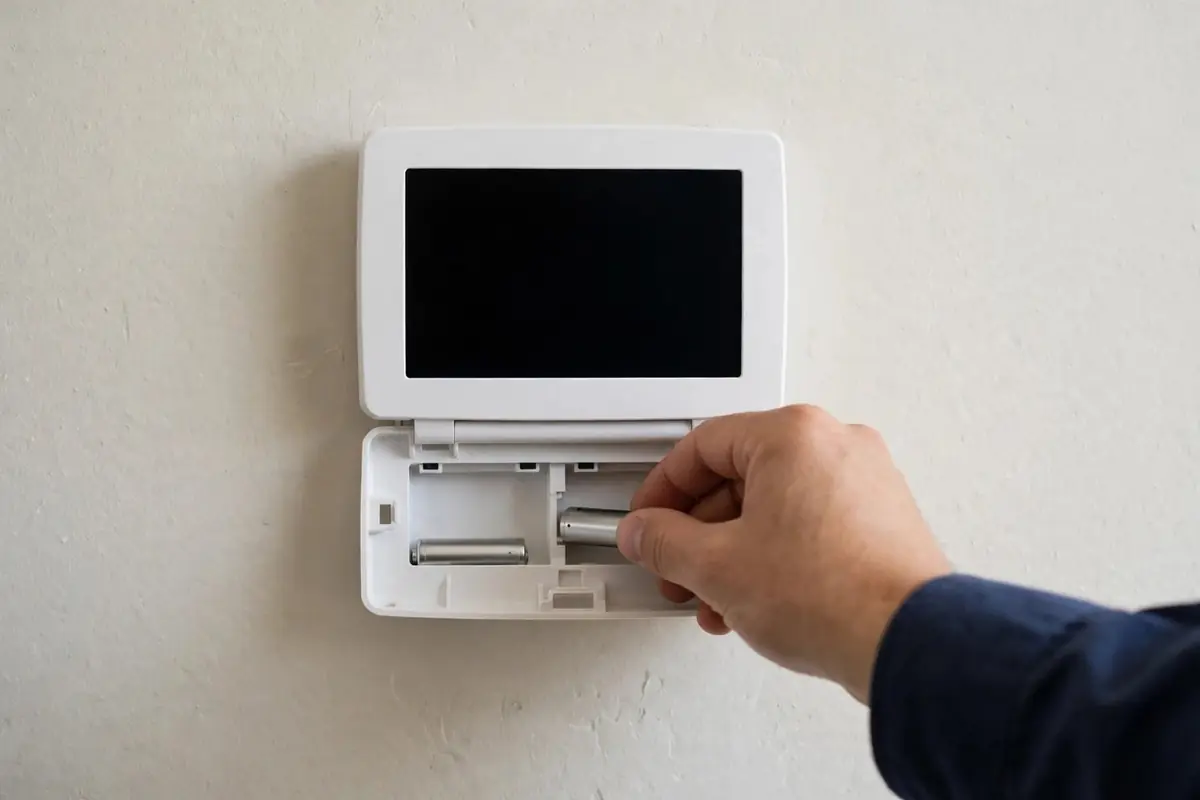
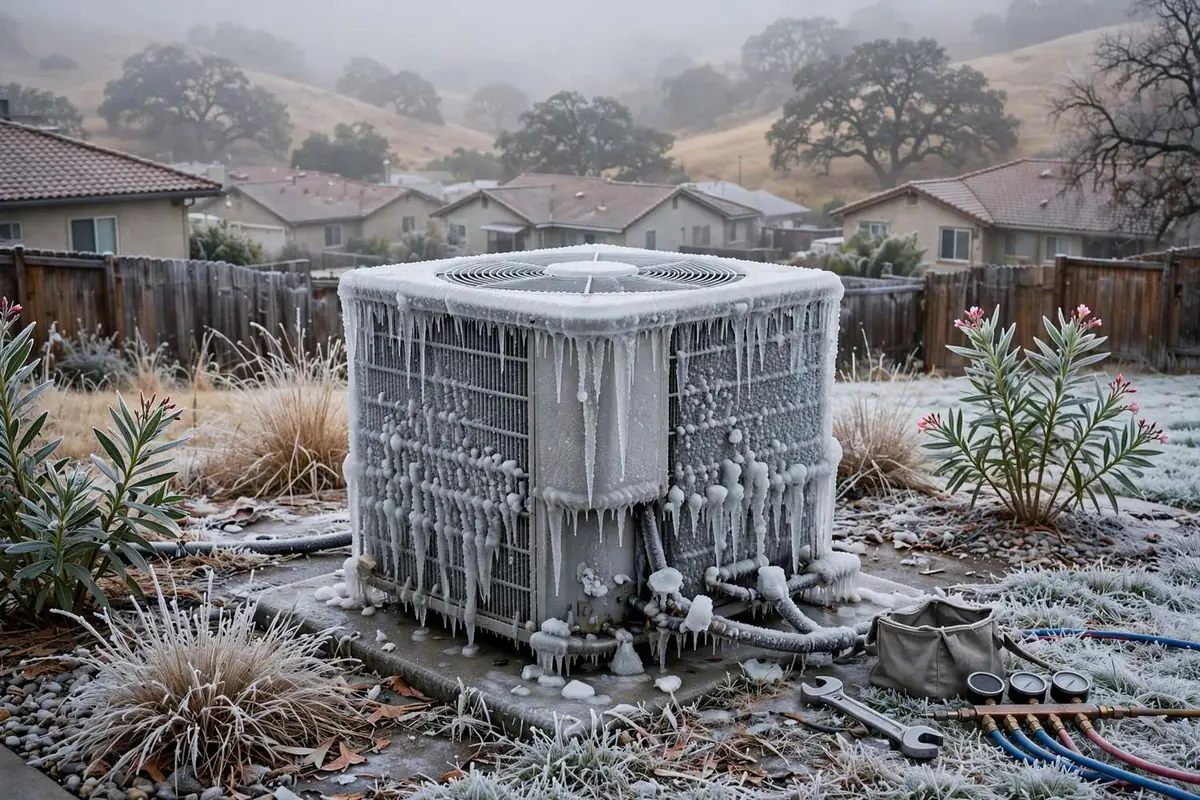
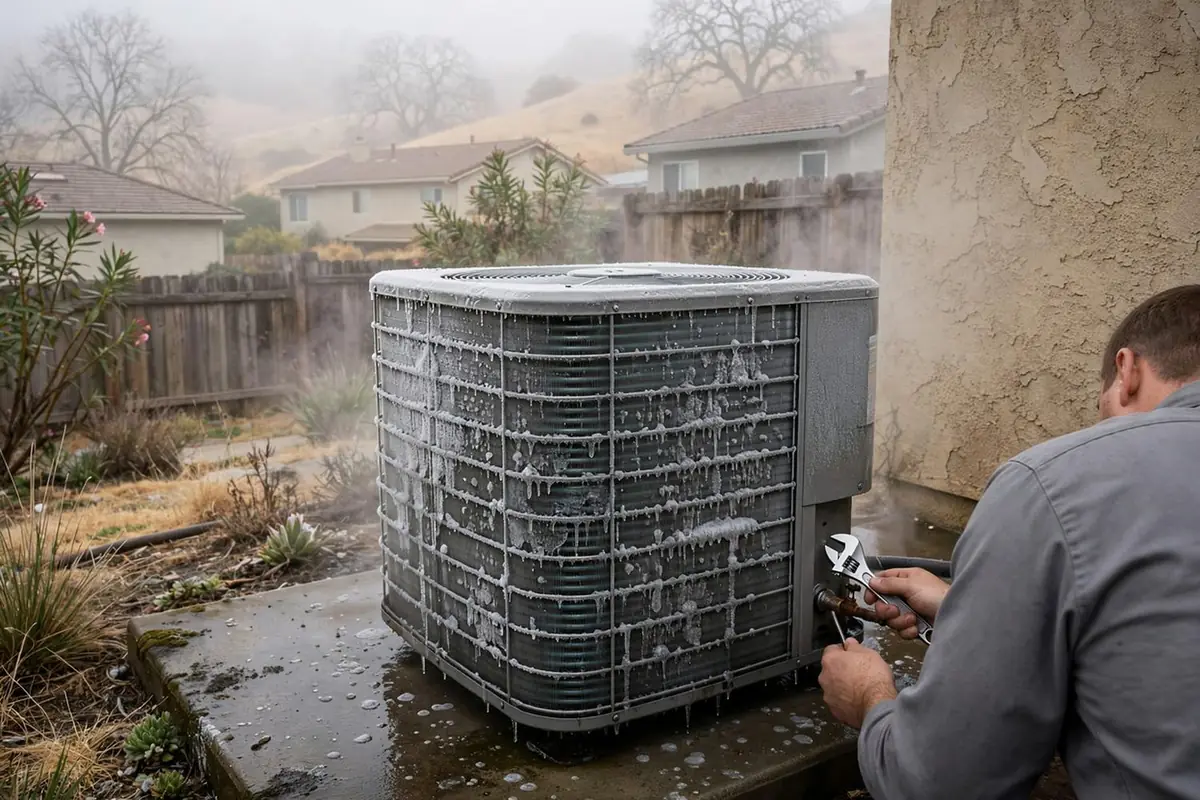
What does a smart thermostat actually do?
At the most basic level it does what any thermostat does: it tells your system to heat, cool or run the fan. The "smart" part is the extras. Wi-Fi control from your phone, schedules that adjust themselves, reports on how long the system ran, sensors in other rooms, and alerts when something looks off.
Some of those extras save energy. Some are just convenient. ENERGY STAR's smart thermostat criteria require certified models to show savings in heating and cooling run time and, for heat pumps, to report how much electric resistance (backup) heat the system uses. That second part matters more than it sounds, and you'll see why below.
Why are heat pumps different?
A heat pump is a central air conditioner that can run in reverse to heat the house. When the house needs more heat than the heat pump can deliver quickly, many systems turn on a backup heat source, usually electric heat strips in the air handler. Thermostats call this "aux heat." Backup strips work like a big toaster. They heat fast, but they use a lot more electricity than the heat pump itself.
Here's the trap. A classic setback schedule (cold house overnight, warm it up fast at 6 a.m.) is fine for a gas furnace. With a heat pump, that morning recovery can call for backup heat. The U.S. Department of Energy has long cautioned that setting back a heat pump in heating mode can make it run inefficiently. Pacific Northwest National Laboratory's thermostat guide recommends thermostats with adaptive recovery, which start warming earlier and more gradually so the heat pump does the work instead of the strips.
If you've seen "aux" or "emergency heat" on your screen and wondered what it meant, the aux and emergency heat explainer covers it in detail.
Do heat pumps even need backup heat in Solano County?
Less than in most of the country. NOAA normals put January average lows around 40°F in Fairfield and Vacaville and about 42°F in Vallejo. Those are easy conditions for a modern heat pump. Most of the time it can carry the house without help, as long as it's sized right and the ducts don't leak badly.
That's exactly why a misconfigured thermostat is so frustrating here. If backup heat kicks on during a 45°F morning in Suisun City, the problem is usually the settings or a repair issue, not the weather. About a third of homes in these cities heat with electricity (ACS 2020-2024), so this affects a lot of households.
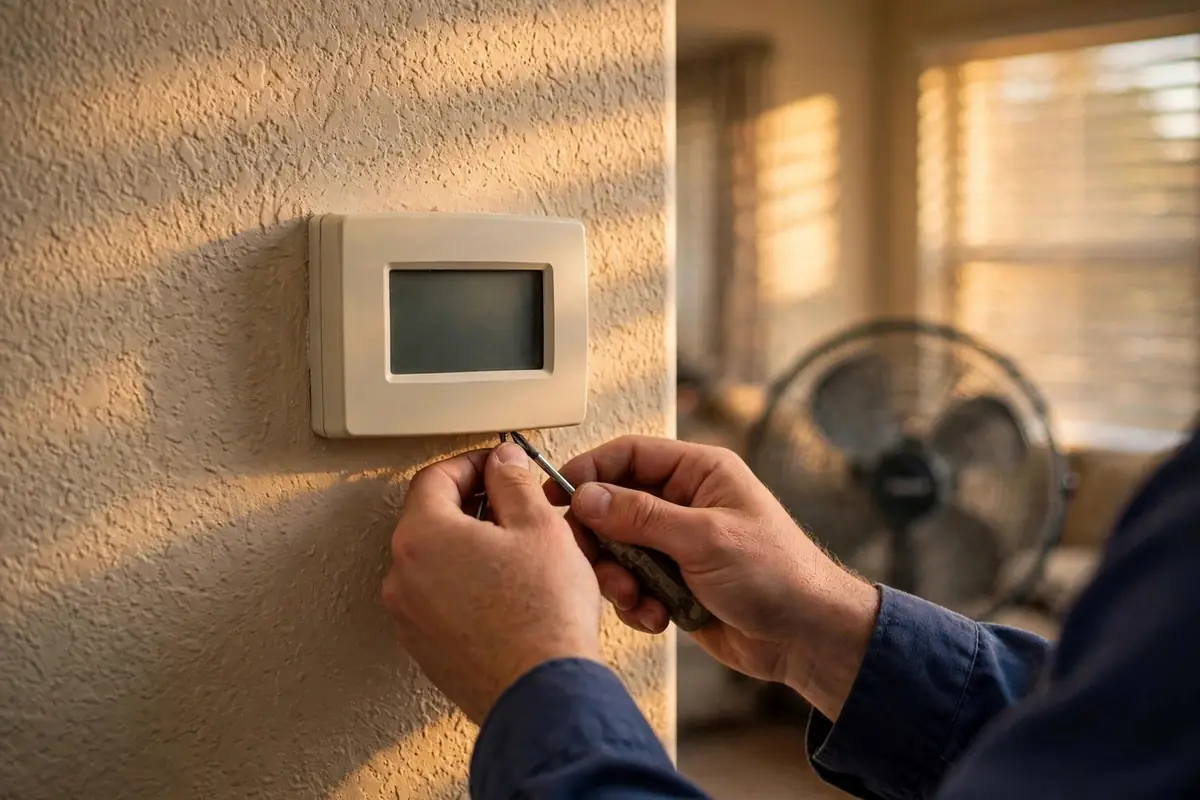
Which settings matter on a heat pump?
| Setting | What it does | What to watch for |
|---|---|---|
| Equipment type | Tells the thermostat it's controlling a heat pump | If set to "furnace" or "conventional," heating may not work right |
| Reversing valve (O/B) | Switches between heating and cooling | Set backward, the system heats when you ask for cooling and the reverse |
| Aux heat lockout | Blocks backup heat above an outdoor temperature you pick | Too high a setting lets strips run on mild days |
| Compressor lockout | Stops the heat pump below a set outdoor temperature | Rarely needed in Solano's climate; set wrong, it hands the job to the strips |
| Recovery or "early start" | Warms the house gradually before a scheduled change | Turn it on for heat pumps; it limits strip use after setbacks |
| Setback size | How far the schedule lowers the temperature | Keep heat pump setbacks small |
If your heat pump maker publishes recommended thermostat settings for your model, follow those over any general advice. Many variable-speed and "communicating" systems also work best, or only fully work, with the manufacturer's own control. Ask before you buy a third-party thermostat for one of those.
What about gas furnaces?
Gas furnaces are the easy case. About six in ten homes in these cities heat with natural gas, and nearly any smart thermostat works with a standard single-stage furnace. Schedules and setbacks behave the way you'd expect: the house cools overnight and the furnace warms it in the morning without a big penalty.
A few things to check:
- Two-stage furnaces need a thermostat that can control both stages, or a setup that lets the furnace stage itself.
- Some older furnaces have no "C" (common) wire at the thermostat. Many smart thermostats need one for steady power.
- If you also have central AC, make sure the cooling wire (Y) and fan wire (G) are connected and configured.
If the furnace stops working after a thermostat swap, start with furnace not turning on before you call anyone.
Can you install a smart thermostat yourself?
Many homeowners do, and it's one of the safer HVAC jobs. Here's how to keep it that way:
- Turn the HVAC system off at the breaker before you touch any wires.
- Take a clear photo of the old thermostat's wiring and labels before disconnecting anything.
- Check the new thermostat maker's compatibility tool with your exact wire labels.
- Label each wire as you remove it.
- Pick "heat pump" or "furnace" correctly in the setup menu, and set the O/B and aux settings to match your system.
Stop and call a pro if you see thick wires or wire nuts behind the old thermostat, or if it's marked 120V or 240V. That's a line-voltage thermostat (common with electric baseboard heaters), and most smart thermostats aren't built for it. Stop too if there's no C wire and you'd need to run a new one or add an adapter at the furnace or air handler. That work happens inside the equipment cabinet.
How do you use a smart thermostat with PG&E time-of-use?
Most PG&E residential time-of-use plans charge more from 4 to 9 p.m. A smart thermostat can help you shift heating and cooling around that window without thinking about it every day:
- Summer: pre-cool a few degrees in early afternoon, then let the setting drift up slightly from 4 to 9 p.m.
- Winter with a heat pump: warm the house gently before 4 p.m. on cold days, and keep evening setbacks small so backup heat doesn't kick in.
- Winter with a gas furnace: the furnace burns gas, but the blower still uses electricity. Schedules matter less for TOU here.
- Check the run-time report each month. If run time climbs with no change in weather, something needs attention.
The full TOU guide is PG&E time-of-use and your AC. Some smart thermostats also offer utility demand-response programs. Read the terms before enrolling so you know how far and how often the program can adjust your setting.
Where should the thermostat go?
Location affects every reading. Avoid spots in direct afternoon sun, next to a supply register, above a lamp or TV, or on an outside wall. In a two-story home, a thermostat downstairs will often leave the upstairs hot in summer. Remote room sensors can help balance that, though they can't fix duct problems. If one floor is always uncomfortable, see why upstairs is hot.
Smart thermostat problems that are really HVAC problems
A new thermostat sometimes gets blamed for something that was already going wrong. Watch for these:
- Blank screen after a power outage. Check the breaker and the furnace or air handler switch. See thermostat blank.
- "Aux" showing often on mild days with a heat pump. Could be a setting, or a heat pump that isn't heating; see heat pump not heating.
- Run times creeping up month after month.
- Indoor temperature never reaching the setting in mild weather.
- The thermostat says heating, but the vents blow cool air.
Settings you can check yourself. Refrigerant, wiring inside the unit and failed parts are jobs for a licensed technician. Call (707) 418-4772 to reach a participating local HVAC company that works on heat pumps and furnaces. Ductless mini-splits are not covered by the line.
Sources
- NOAA NCEI, U.S. Climate Normals 1991–2020 (station files for Vacaville, Nut Tree Airport, Fairfield, Vallejo)
- U.S. Census Bureau, American Community Survey 2020–2024 5-year (tables B25003, B25035, B25040), via Census Reporter
Last reviewed 2026-11-12 by the RD Heat & Air editorial team. Editorial policy.