Why is one room colder than the rest of the house?
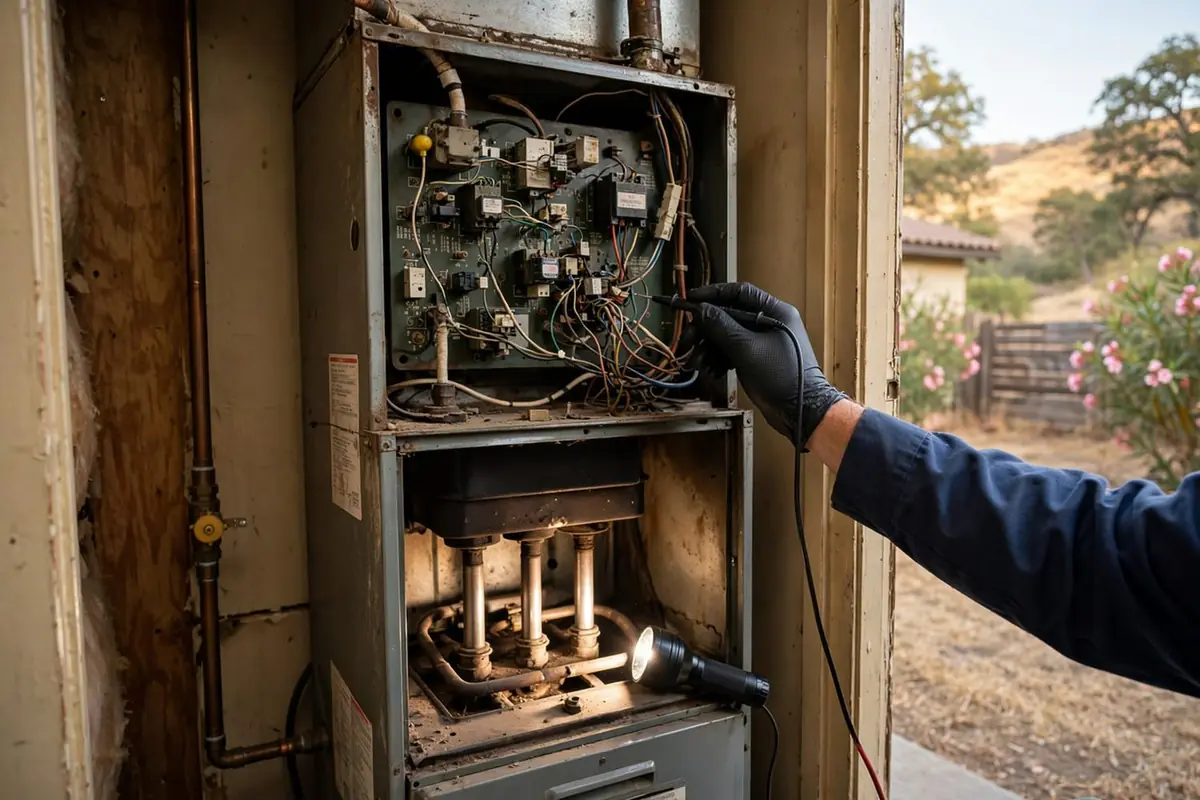
A forced-air furnace heats the house by pushing warm air through ducts to every room, then pulling air back through return grilles. The thermostat sits in one spot, usually a hallway, and shuts the furnace off once that spot is warm. If one room gets less air than it needs, or loses its heat faster than the hallway does, that room ends up behind every single cycle.
So the question is almost always one of two things:
- Not enough warm air is reaching the room. The duct is leaking, crushed, too long, too small, or closed off somewhere.
- The room loses heat faster than the others. It sits over a garage, faces north, has a big window or sliding door, or has an outside wall on three sides.
Often it's both. Honestly, a bedroom at the far end of a long attic duct run that also sits over an unheated garage is the classic cold room in a lot of Solano County tract homes.
A useful first test: put your hand over the supply vent in the cold room while the furnace runs, then do the same in a room that feels comfortable. If the cold room's vent pushes clearly less air, or the air feels lukewarm, the problem is delivery. If the airflow feels about the same, the room is probably losing heat faster than it gets it.
What should you check yourself first?
These are safe for anyone, renters included. Do them before you pay for a visit, because a fair share of "cold room" calls end at a blocked vent or a filter nobody has changed since spring.
- The supply vent in the cold room is fully open, and nothing (a bed, dresser, rug or curtain) is covering it.
- The room's door isn't kept shut all day. If it is, test with it open for a day and see if the room warms up.
- The furnace filter is clean. A clogged filter cuts airflow to the whole house, and the farthest rooms feel it first.
- Vents in other rooms aren't closed. Closing vents doesn't push more air to the cold room in a predictable way; it mostly raises pressure in the ducts.
- The thermostat fan is on Auto, not On, so you're not judging the room by room-temperature air between cycles.
- Large return grilles (usually in the hallway or ceiling) aren't blocked by furniture or stored boxes.
- Windows in the cold room close and lock fully, and the weatherstripping on any exterior door isn't torn.
If the filter was the problem, the whole house usually feels better within a day. For more on filter changes and first-cold-snap prep, see the furnace fall checklist.
Is the duct to that room damaged or leaking?
In most Solano County single-story homes and many two-story ones, the ducts run through the attic. Most homes built in the 1970s and 1980s use flexible duct: a plastic inner liner wrapped in insulation with an outer jacket. Flex duct is quick to install, but it has some weak points that show up as cold rooms:
- Crushed or kinked runs. Someone storing boxes, running cable, or installing solar or insulation steps on a duct, or pulls it tight around a truss. A kink can choke off most of the air to one room.
- Sagging runs. Long flex runs that droop between supports add resistance, so less air makes it to the end.
- Disconnected joints. The tape or strap at a connection fails and the duct slips off its collar. That room's warm air is now heating the attic.
- Torn liners. Rodents, old age or rough handling tear the inner liner, so air leaks out along the length of the run.
Age matters here. According to U.S. Census American Community Survey data, the median home in Fairfield was built in 1986, Vacaville in 1985, Suisun City in 1984, Benicia in 1981 and Vallejo in 1975. In plenty of those homes the attic ducts are original, which means they're 35 to 50 years old. Flex duct jackets and tapes from that era often turn brittle.
California takes duct leakage seriously. Under the 2025 Energy Code, when a central furnace or AC is replaced, the existing ducts generally have to be tested and sealed, with a target of no more than 10% total leakage or 7% leakage to the outside, according to the California Energy Commission's HVAC FAQ. That test often turns up exactly the disconnected or torn runs that cause cold rooms. More on that in the Title 24 permits guide.
Homeowners can look into the attic from the access hatch with a flashlight, but walking the attic means stepping only on framing, avoiding wiring, and dealing with insulation. Most people are better off leaving that to the technician. One wrong step and you have a foot through the ceiling drywall.
Can the room get air back to the furnace?
Warm air can only flow into a room if roughly the same amount of air can flow back out. Many homes from the 1970s through the 1990s have just one or two large central return grilles in the hallway. When a bedroom door is shut, the air pushed into that room has nowhere to go. Pressure builds up, and the vent delivers less and less air.
Signs the return path is the problem:
- The room is fine with the door open and cold with it closed.
- The door whistles, moves or slams by itself when the furnace starts.
- There's a strong draft under the door toward the hallway.
Fixes a technician might suggest include a dedicated return duct from the room, a transfer grille (a short path through the wall or ceiling into the hallway), or a jumper duct through the attic. Trimming the bottom of the door helps a little, but it's rarely enough for a big bedroom.
Could a damper be closed?
Some duct systems have manual balancing dampers: a small metal plate inside the duct with a lever or wing nut on the outside. They're usually near the furnace, at a branch takeoff in the attic, or at the main trunk. Installers set them to balance airflow. Over the years, someone may have closed one to push more air elsewhere for summer cooling, then forgot about it.
Homes with a zoning system have motorized dampers controlled by a zone panel and several thermostats. A motor that fails in the closed position can leave a whole zone, often upstairs or a bonus room, cold. If a zoned home suddenly has one cold area, the zone damper is near the top of the list.
Two-story homes have their own pattern: heat rises, so upstairs often runs warm in winter and hot in summer, while downstairs rooms at the far end get the short straw. For the summer side of that problem, see why upstairs is hot, and for the zoning question see zoning for two-story homes.
Is the room itself losing heat too fast?
Some rooms are simply harder to heat. Common examples in Solano County homes:
- Rooms over the garage. The floor sits above unheated space. If the floor insulation was skimped, fell down or was never installed, the floor itself pulls heat out of the room.
- Converted garages and additions. These often got a duct tapped off the nearest run without anyone checking whether the furnace and ducts could carry the extra load.
- Rooms with large single-pane windows or sliding doors. Glass loses heat much faster than an insulated wall.
- Corner rooms and north-facing rooms. More outside wall, less winter sun.
- Rooms with a missing patch of attic insulation. Insulation gets pushed around when someone runs cable or works on the roof.
Solano County winters are mild compared with much of the country, but the nights still get cold. NOAA's 1991–2020 normals put the average January low at about 40°F in Fairfield and Vacaville and 42°F in Vallejo, and the Vacaville downtown station averages around 14 nights a year at or below freezing. On a clear winter night, a poorly insulated room over a garage notices.

Is the furnace or blower part of the problem?
Sometimes the cold room is the first sign of a whole-system issue:
- A dirty blower wheel or low blower speed. Less total airflow means the far rooms lose out first.
- Short cycling. If the furnace runs only a few minutes at a time, distant rooms never get a full dose of warm air. See furnace short cycling.
- A furnace that's too small for an addition. The original furnace was sized for the original house.
- Lukewarm air everywhere. If every vent feels cool, the problem isn't one room. Start with furnace blowing cold air.
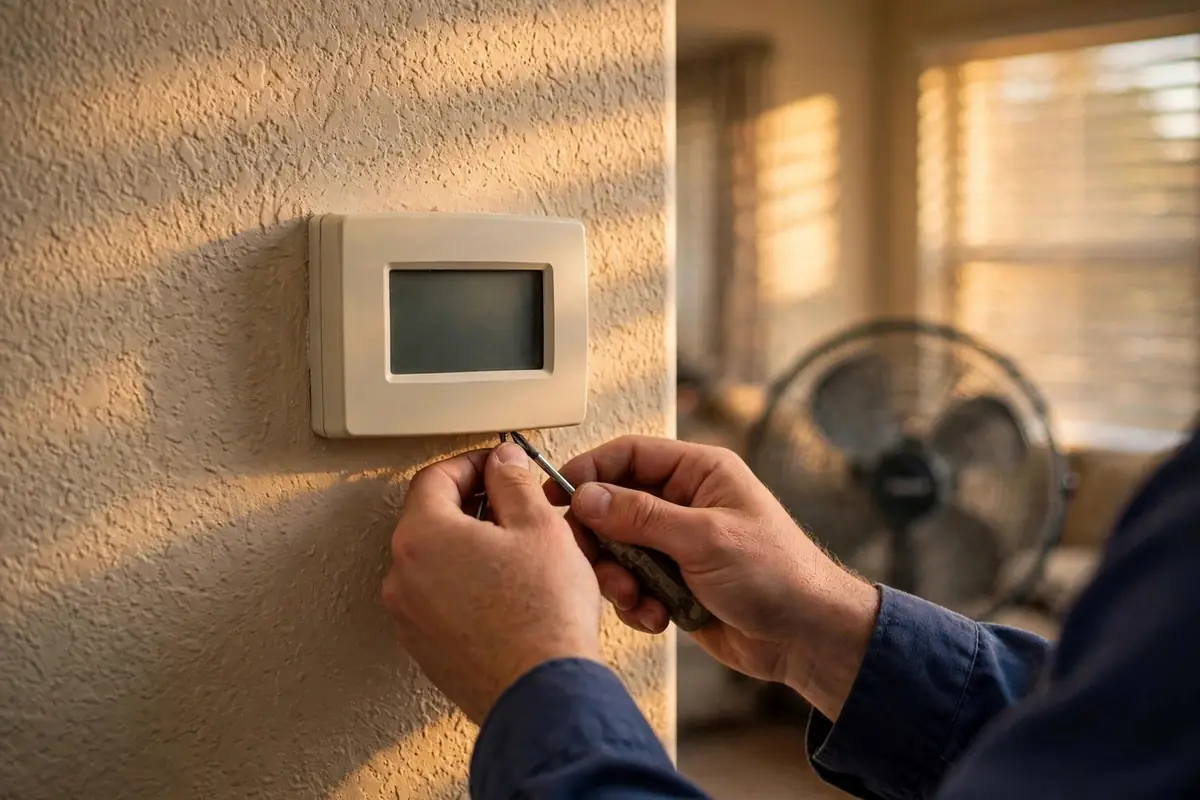
Thermostat location matters too. A thermostat on a wall that gets afternoon sun, or one near a kitchen, will shut the furnace off early and leave the colder rooms behind.
What usually causes it? A quick table
| What you notice | Likely cause | Who fixes it |
|---|---|---|
| Weak airflow from just one vent | Crushed, kinked or disconnected attic duct; closed damper | HVAC technician |
| Room fine with door open, cold with it closed | No return path | HVAC technician (return or transfer grille) |
| Weak airflow everywhere | Dirty filter, dirty blower, blower problem | You (filter), then technician |
| Good airflow but the room stays cold | Heat loss: windows, floor over garage, missing insulation | Insulation or window work; technician can check duct sizing |
| Cold room started after attic work | Duct stepped on or disconnected | HVAC technician |
| One area cold in a zoned home | Zone damper or zone control fault | HVAC technician |
| Cold room is an addition or converted garage | Duct undersized or system not sized for it | HVAC technician (load and duct design) |
What will a technician do?
A good technician treats a cold room as an airflow problem first and a furnace problem second. Expect some mix of these:
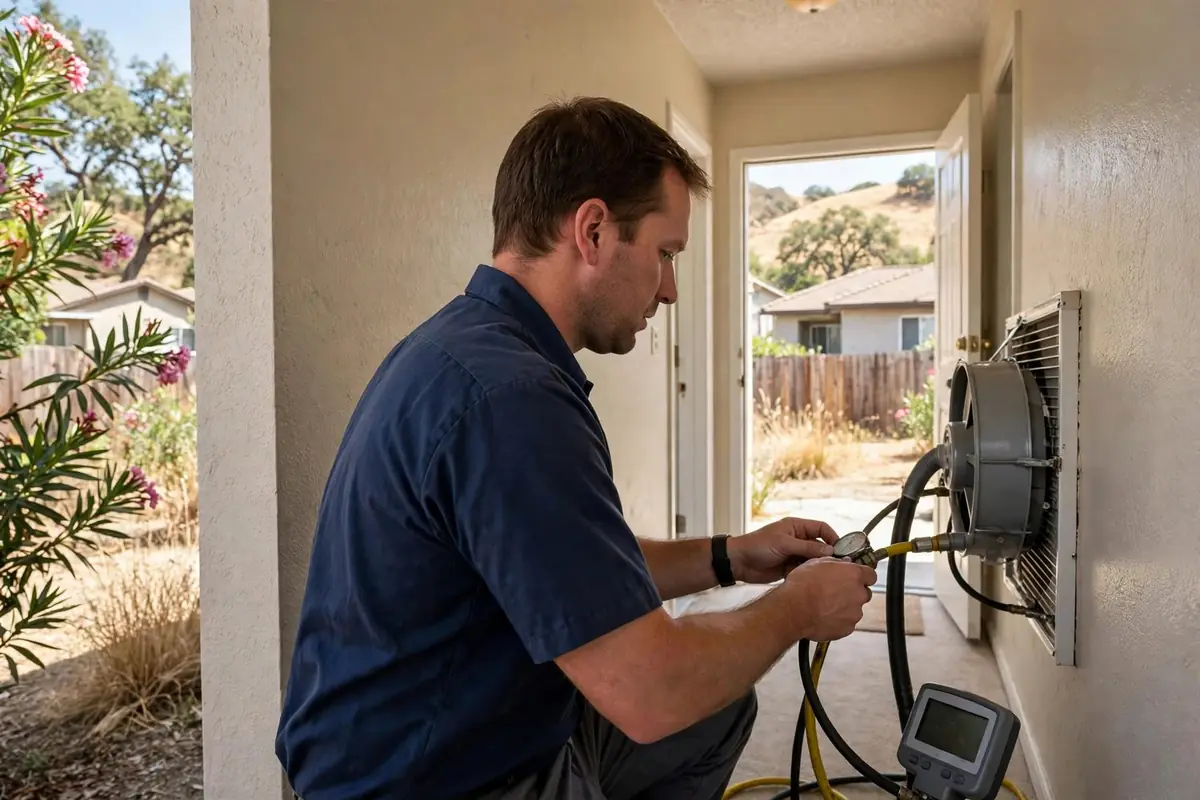
- Measuring supply air temperature and airflow at the cold room and at a comfortable room for comparison.
- Checking the filter, blower and furnace temperature rise to rule out a whole-system problem.
- Inspecting the attic duct to that room for kinks, sags, disconnects and tears.
- Finding and checking any balancing or zone dampers.
- Testing pressure in the room with the door closed to judge whether a return path is needed.
- For additions or a long-standing problem, running a room-by-room load calculation to see whether the duct to that room is big enough.
Repairs range from reconnecting and sealing a single run to replacing a section of duct, adding a return, or redesigning part of the system. Cost depends on attic access, how many runs need work, and whether a permit and duct test apply. The repair cost factors guide explains what drives the price without quoting numbers.
When should you call?
Call if the simple checks didn't help, airflow from one vent is clearly weaker than the others, the problem started after attic work, or you can see a disconnected duct from the attic hatch. RD Heat & Air is a referral line, not a contractor. Calling (707) 418-4772 connects you with a participating local heating company that serves Fairfield, Vacaville, Suisun City, Benicia, Dixon and Vallejo.
Before you call, jot down which room is cold, whether it's worse with the door closed, roughly how strong the vent airflow feels, and whether anyone has been in the attic recently. That saves time on the visit. If the whole house is cold, see furnace repair instead.
Sources
- U.S. Census Bureau, American Community Survey 2020–2024 5-year (tables B25003, B25035, B25040), via Census Reporter
- NOAA NCEI, U.S. Climate Normals 1991–2020 (station files for Vacaville, Nut Tree Airport, Fairfield, Vallejo)
- California Energy Commission, Energy Code Support Center: HVAC FAQ
Last reviewed 2026-11-12 by the RD Heat & Air editorial team. Editorial policy.