What does a furnace limit switch do?
Every gas furnace has a heat exchanger, a metal chamber where the flame burns. The blower pushes house air across the outside of it and carries that heat to your rooms. As long as enough air flows across it, the heat exchanger stays within a safe temperature range.
The high-limit switch watches that temperature. It's a small sensor mounted on the furnace cabinet near the heat exchanger or in the warm-air section. If the temperature climbs too high, the switch opens and the control board shuts the gas valve. The blower keeps running to cool things down. Once the temperature drops, the switch closes again and the furnace can relight.
That's a good thing. An overheated heat exchanger can crack over time, and a cracked heat exchanger is the kind of problem that ends a furnace and can let combustion gases into the airstream. The limit switch is there to stop that from happening.
What a limit trip looks and sounds like
Most people never see the switch itself. They notice a pattern:
- The furnace lights and runs normally for a few minutes.
- The burners shut off, but the blower keeps running.
- The air from the vents goes from hot to lukewarm to cool.
- After a while the burners light again, and the cycle repeats.
- The house warms slowly, or never quite reaches the setpoint.
On many modern furnaces, the status light blinks a specific code for a limit trip. The chart is usually printed on a label inside the door. Some control boards lock the furnace out for a while after several trips in a row, so a furnace that's been tripping all morning may just stop and sit there blinking.
This is one of the most common reasons behind furnace short cycling, and it often shows up as a furnace blowing cold air between cycles.
Why does the limit switch keep tripping?
Honestly, most of the time the furnace isn't too hot because of the burners. It's too hot because not enough air is moving through it. Here's the usual list, in rough order of how often it comes up:
| Cause | Clues | Who handles it |
|---|---|---|
| Clogged air filter | Filter is gray or packed with dust and hair | You |
| Closed or blocked supply vents | Several rooms closed off, rugs or furniture over registers | You |
| Blocked return grille | Couch, boxes or a bed pushed against the return | You |
| Filter too restrictive for the system | Trips started after switching to a thicker or higher-rated filter | You, then a technician to confirm |
| Dirty blower wheel | Weak airflow even with a new filter | Technician |
| Failing blower motor or capacitor | Blower hums, runs slow or takes a while to start | Technician |
| Crushed, kinked or disconnected ducts | Some rooms weak, others fine; attic or crawlspace work done recently | Technician |
| Ducts too small for the furnace | Problem started with a new or larger furnace | Technician |
| Zoning dampers closing too much air off | Trips when only one zone calls | Technician |
| Weak or failed limit switch | Trips even with good airflow | Technician |
| Overfiring or gas pressure issue | Airflow checks out, still runs hot | Technician |
What you can safely check first
The homeowner side of this is mostly about airflow, and it fixes a lot of cases.
- Replace the filter. Don't just look at it; if you can't remember when it was changed, change it. The furnace filter guide covers sizes and ratings.
- Make sure the filter is the right size and installed with the airflow arrow pointing toward the furnace.
- Open every supply register in the house, including rooms you don't use.
- Move furniture, beds and storage off registers and away from the return grilles.
- Check that the furnace door panel is fully seated.
- Reset once: furnace switch off for about a minute, then back on. Watch one full cycle.
If the furnace runs normally for a full day after these steps, the filter or a blocked vent was probably the cause. If it still trips, stop resetting it and book a visit. A furnace that trips its limit all day is cycling its heat exchanger hot over and over, and that's wear you don't want.
High-limit vs rollout switch: why the difference matters
Furnaces have more than one temperature safety, and they don't mean the same thing.
The main high-limit switch resets itself automatically. It's built to trip and recover. A trip here usually points to airflow.
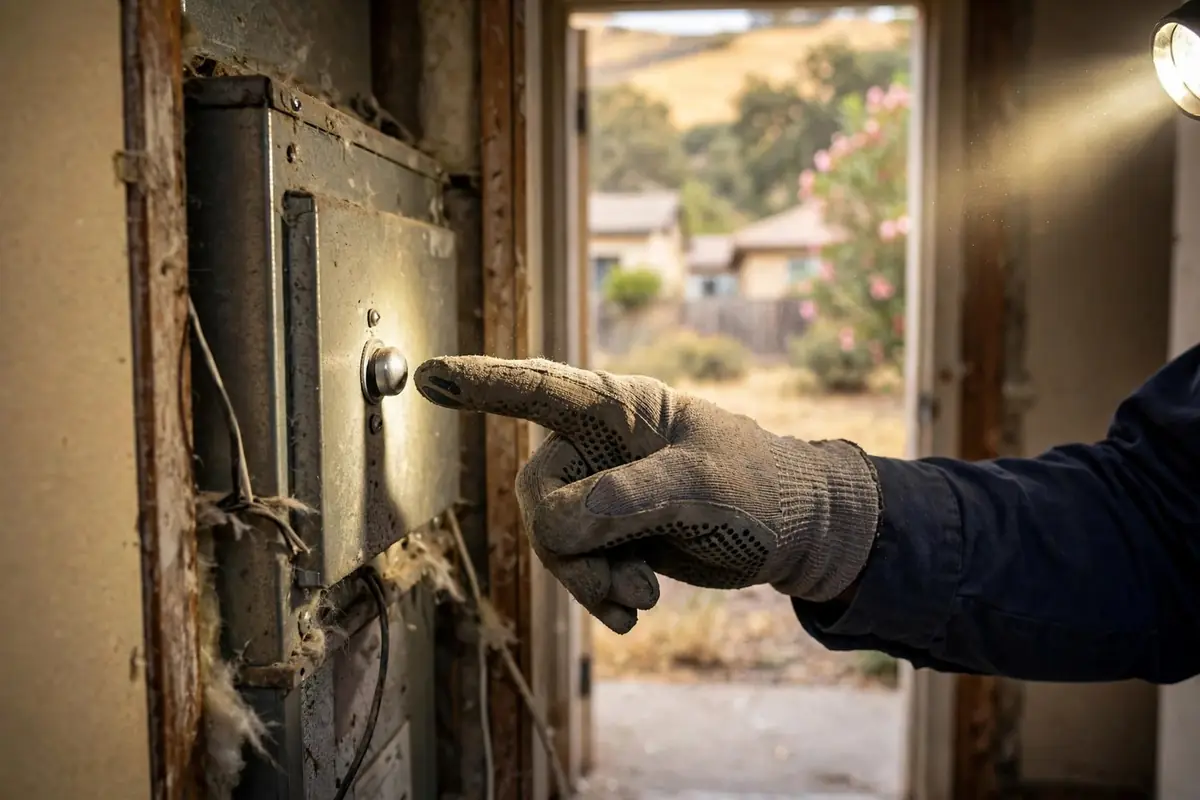
A flame rollout switch is different. It sits near the burners and trips if flames roll out of the burner area instead of going into the heat exchanger. That can happen when the heat exchanger or vent is blocked, or when the heat exchanger is cracked. Rollout switches are usually manual reset, with a small button, and many control boards blink a separate code for them.
Some furnaces mounted sideways in attics or upside down (downflow) also have an auxiliary limit near the blower, which may be manual reset too.
Here's the rule to follow: if a manual-reset switch has tripped, don't keep pressing the button. A tripped rollout switch is a combustion warning. Turn the furnace off and have a technician find out why. Make sure your CO alarms work in the meantime. The CO alarm guide covers California's requirements.
Why attic furnaces in Solano County trip more often
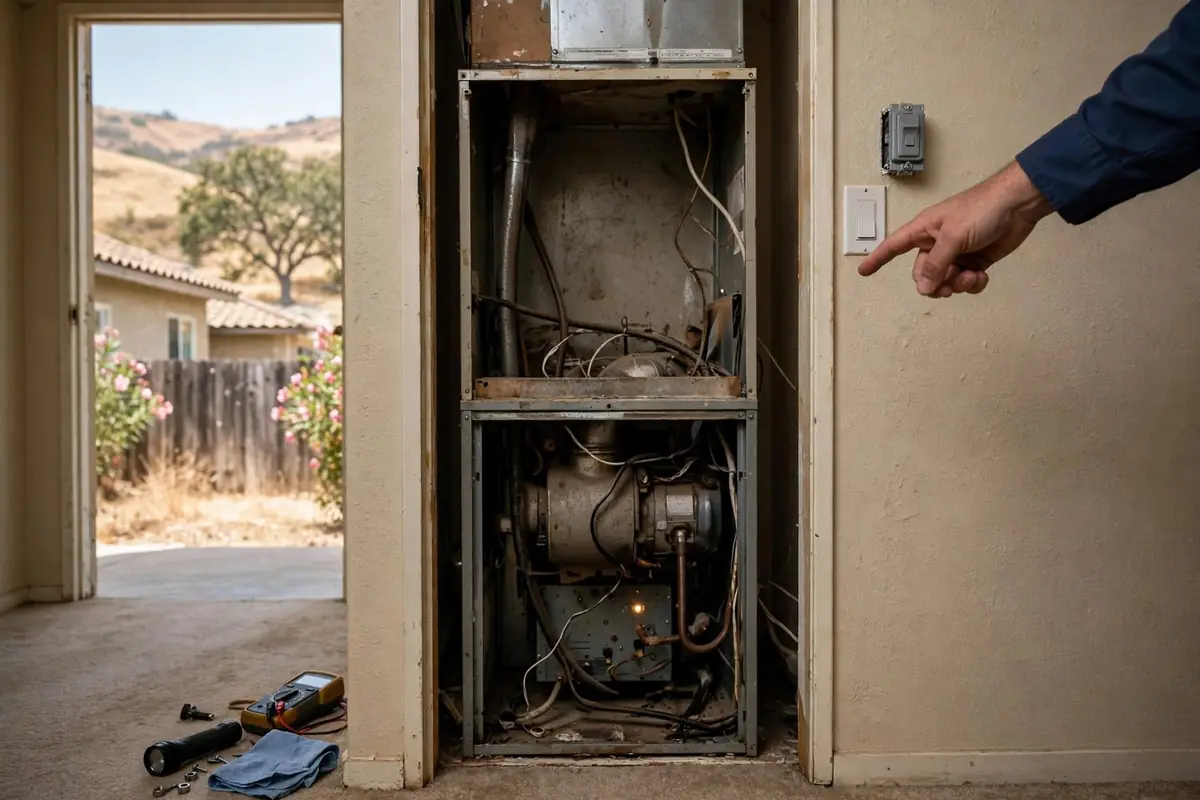
A lot of Fairfield and Vacaville homes from the 1980s have the furnace in the attic or garage, lying on its side, connected to long runs of flexible duct. The median home in Fairfield was built in 1986 and in Vacaville in 1985 (Census ACS), so much of that ductwork has spent decades in a hot attic.
Flex duct sags, kinks and gets stepped on. It gets crushed under new insulation, flattened by cable or solar installers, or pulled off its fitting. Every one of those cuts airflow back to the furnace. In summer you notice it as weak cooling upstairs. In winter, the same restriction can push the furnace into its high limit.
The attic furnace guide and the attic ductwork guide cover those layouts in more detail. If your limit trips started right after someone worked in the attic, mention that when you call. It narrows things down fast.

Can a new furnace trip its limit?
Yes, and it's frustrating when it happens. A brand-new furnace that trips its limit usually points to a mismatch between the furnace and the ducts. If a larger furnace went in on the same old ducts, or the blower speed wasn't set up for the house, the system can't move enough air across the heat exchanger.
A good installer measures airflow and checks the temperature rise (how much the air warms up crossing the furnace) against the range printed on the furnace's rating plate. If you have a newer furnace that trips, ask the installing company to come back and check those numbers.
Under California's 2025 Energy Code, which applies to permits submitted on or after January 1, 2026, replacing a furnace or other space-conditioning equipment generally needs a permit and duct leakage testing by an ECC-Rater. The Title 24 permit guide explains that process.
What the technician checks on a limit call
A careful diagnosis covers more than swapping the switch. Expect the technician to:
- Read the fault code history on the control board.
- Check the filter, blower wheel and blower motor.
- Measure the temperature rise across the furnace and compare it with the rating plate.
- Measure static pressure in the ducts to see how hard the blower is working.
- Test the limit switch itself.
- Check gas pressure and look at the flame.
- Inspect the heat exchanger, especially if the furnace has been tripping for a long time.
Be a little wary of a fix that's only a new limit switch with no airflow testing. If the old switch was doing its job, a new one will trip too. And never accept a limit switch being bypassed or jumped. That removes the furnace's main overheat protection.
Cost depends on what's found, the furnace brand and how hard the unit is to reach. The repair cost factors guide explains what moves the price.
When to call
Call after the filter and vent checks if any of these are true:
- The furnace still shuts off its burners every few minutes.
- It's locked out and blinking a code.
- A manual-reset rollout or auxiliary limit has tripped.
- You smell something hot or electrical, or a CO alarm sounds.
- The blower sounds weak or is humming without spinning.
Tell the technician how long the cycles last, what code is blinking, how recently the filter was changed and whether anyone has worked in the attic. RD Heat & Air connects callers with participating local heating companies across Solano County. Call (707) 418-4772. If you smell gas, leave the house and call 9-1-1 and PG&E at 1-800-743-5000 from outside first.
Sources
- U.S. Census Bureau, American Community Survey 2020–2024 5-year (tables B25003, B25035, B25040), via Census Reporter
- California Energy Commission, Energy Code Support Center: HVAC FAQ
- California Energy Commission, 2025 Energy Code overview
- PG&E, Gas safety and emergencies
Last reviewed 2026-11-27 by the RD Heat & Air editorial team. Editorial policy.