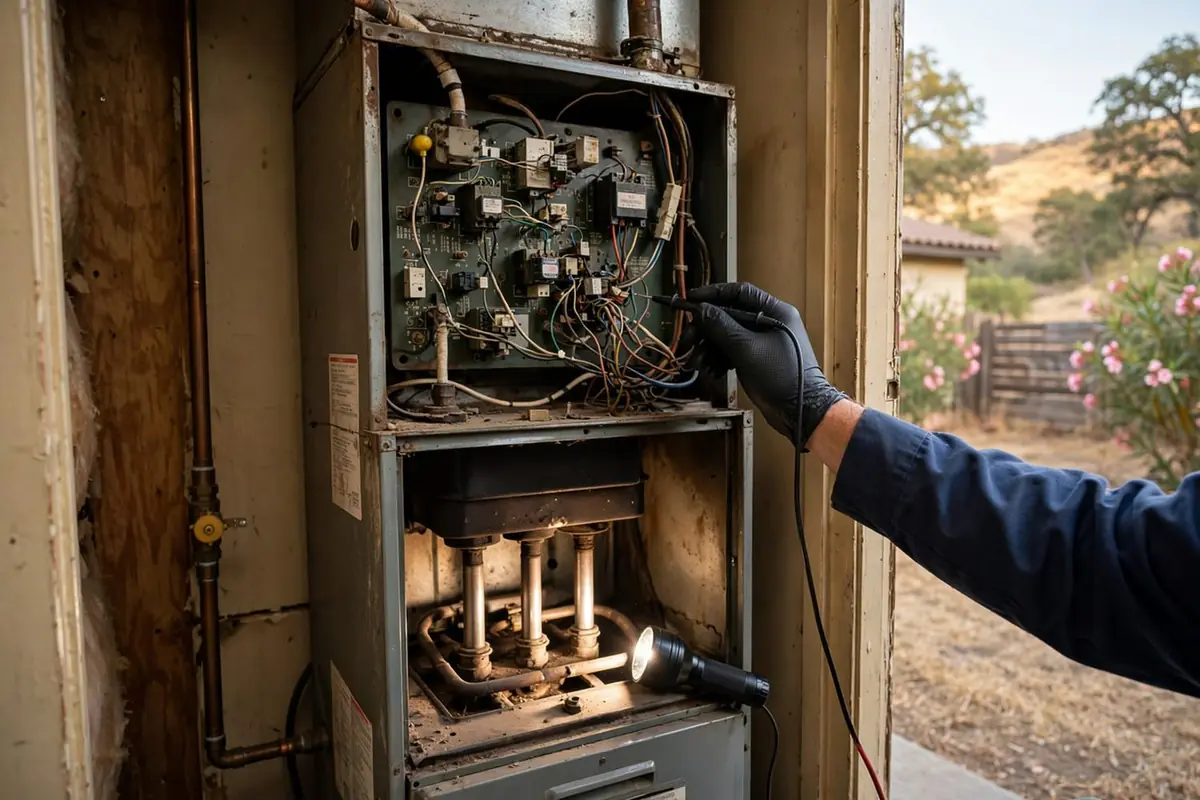
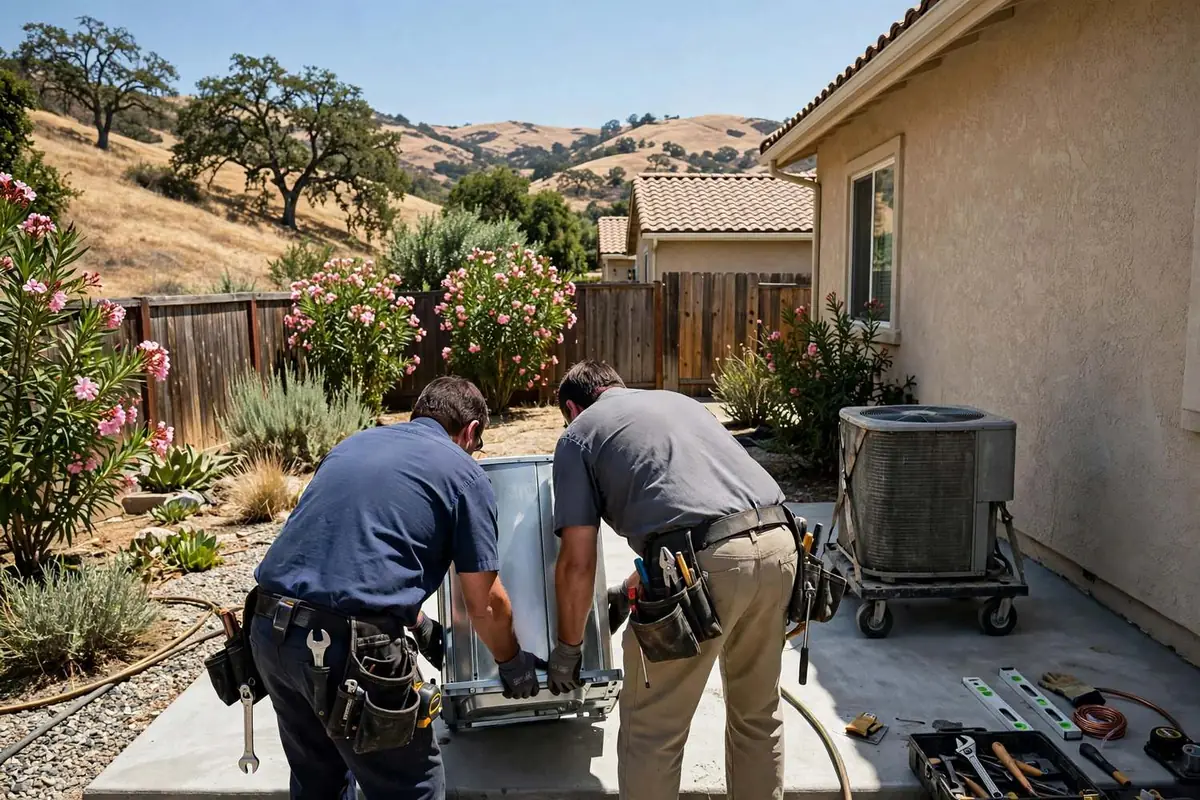
Why is the furnace in the attic?
Plenty of single-story California homes built in the 1970s and 1980s have the furnace in the attic, or in a garage with the ducts running overhead. Builders liked the attic because it saved floor space, kept the ducts short, and let one crew run the furnace, the AC coil and the ducts in a day.
That era is exactly what most of Solano County is made of. According to U.S. Census American Community Survey data, the median home was built in 1986 in Fairfield, 1985 in Vacaville, 1984 in Suisun City, 1981 in Benicia and 1988 in Dixon. Many of those homes are on their second or third furnace, and some of the ducts, platforms and drain lines are still original.
Not sure where yours is? Look for a ceiling hatch in a hallway or closet. A large return grille in the hallway ceiling with the filter behind it is a strong hint the furnace is directly above.
What goes wrong most often with attic furnaces?
Honestly, most attic furnace calls come down to the same short list:
| Problem | What you notice | Why the attic makes it worse |
|---|---|---|
| Clogged condensate drain | Ceiling stain, drip from a ceiling light, AC or furnace suddenly shuts off | Water collects above living space, not on a garage floor |
| Forgotten filter | Weak airflow, whistling, short cycling | Out of sight, out of mind |
| Leaky or crushed ducts | Cold or hot rooms, dusty house, high bills | Long runs of old flex duct in a space nobody walks |
| Heat-aged parts | Failed capacitor, brittle wiring, failed control board | Summer attic heat bakes everything up there |
| Rodent damage | Chewed wires, torn duct, odors | Attics are quiet, warm and rarely checked |
| Venting problems | Rusty or disconnected flue, CO alarm | Hard to see without going up |
The rest of this post goes through each one.
Why is there a water stain on the ceiling under the furnace?
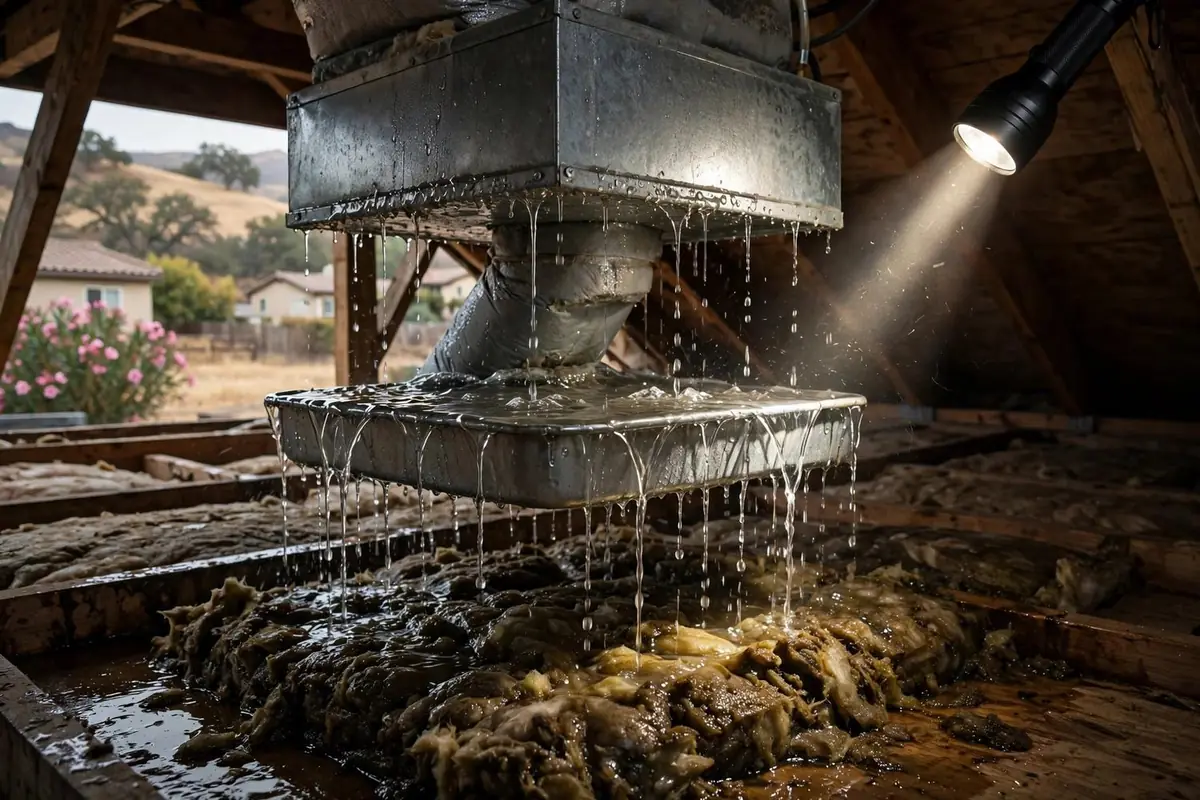
Water is the number one attic problem, and it often has nothing to do with heating. In most homes the AC's indoor coil sits on top of the furnace in the same cabinet. All summer that coil pulls water out of the air and sends it down a drain line. High-efficiency furnaces (often called 90% furnaces) also make water in winter, because they squeeze enough heat out of the exhaust that it condenses.
That water has to go somewhere. When the drain clogs with algae, dust or debris, it backs up. Most attic installs have a secondary pan under the unit and a float switch that shuts the system off when water rises. If the pan has rusted through, the switch is missing, or the backup drain is also clogged, water ends up on your drywall.
What you can do:
- Turn the system off at the thermostat as soon as you see a stain or a drip.
- Look for a small pipe sticking out under an eave or over a window. Water dripping from it while the AC runs often means the main drain is clogged and the backup is working. That's your early warning, so call.
- Catch drips with a towel or bucket and keep people away from a sagging ceiling.
Don't climb up to dig at the drain yourself unless you're comfortable walking an attic safely on the framing. For the cooling-season version of this problem, see AC leaking water.
Where is the filter on an attic furnace?
Usually it isn't at the furnace. Most attic systems use a filter grille in the hallway ceiling or high on a wall. You swing the grille down (it often has two clips or thumb latches) and the filter slides out. Some homes have a second filter at the furnace itself. Ask the technician to show you whether yours does.
A clogged filter on an attic system causes the same trouble as anywhere else: weak airflow, a furnace that overheats and shuts off on its high-limit switch, and a frozen AC coil in summer. The difference is that nobody notices the filter is the problem because they forgot it exists.
- Find the return grille and write the filter size (printed on the filter's edge) on the inside of a cabinet door.
- Check it monthly during heavy heating or cooling, and during wildfire smoke.
- Use a step stool with a helper; the grille may drop open suddenly.
- Make sure the airflow arrow on the filter points toward the duct, not into the room.
For filter types and MERV ratings, see the furnace filter guide.
How does summer heat affect an attic furnace?
An attic in an inland Solano County summer is brutal. NOAA's 1991–2020 normals put the average July high at 97.3°F in downtown Vacaville and 89.6°F in Fairfield, with Vacaville averaging about 28 days a year at 100°F or hotter. Attics run far hotter than that outdoor air on sunny afternoons.
The furnace isn't running in July, but its parts are still sitting up there. Years of that heat dry out wire insulation and plastic connectors, age capacitors on blower motors, and make old flex duct jackets brittle. It also means AC air moving through attic ducts picks up heat before it reaches your rooms, which is one reason attic duct leaks hurt so much in summer. If your home is two stories, see why upstairs is hot for the cooling side.
In winter it's the opposite. The attic is close to outdoor temperature, so leaky ducts dump warm air into a cold space instead of your rooms. With January lows averaging about 40°F in Fairfield and Vacaville, that loss adds up over a season.
Are attic ducts leaking?
Probably, at least a little, if they're original. Ducts from the 1980s were usually flex duct joined with tape or straps, and decades of attic heat break that tape down. Joints slip, liners tear, and contractors working on solar, wiring or insulation step on runs.
California's Energy Code sets a clear standard here. When a central furnace or air conditioner is replaced, existing ducts generally have to be tested and sealed. The 2025 code target is no more than 10% total leakage or 7% leakage to the outside, according to the California Energy Commission. A third-party ECC-Rater (formerly called a HERS Rater) verifies the result.
So if you're replacing an attic furnace, plan on duct work being part of the job. If one room is always cold or hot, see why one room is always cold.

Is an attic furnace a carbon monoxide risk?
Any gas furnace can be, and attic units are harder to keep an eye on. The flue pipe that carries exhaust up through the roof can rust, separate at a joint, or get knocked loose. Since nobody's up there, a problem can go unseen for a long time.
Your part is simple: keep working carbon monoxide alarms on every level and near bedrooms, test them, and replace them on the schedule on the label. If an alarm sounds, get everyone out, then call 9-1-1 and PG&E at 1-800-743-5000 from outside. If you smell gas anywhere in the house, do the same.
A technician doing a heating check should look at the flue connection, the vent cap on the roof where visible, and the burners and heat exchanger. Ask about it if they don't mention it. See burning or gas smell for more.
Why is attic furnace repair sometimes slower?
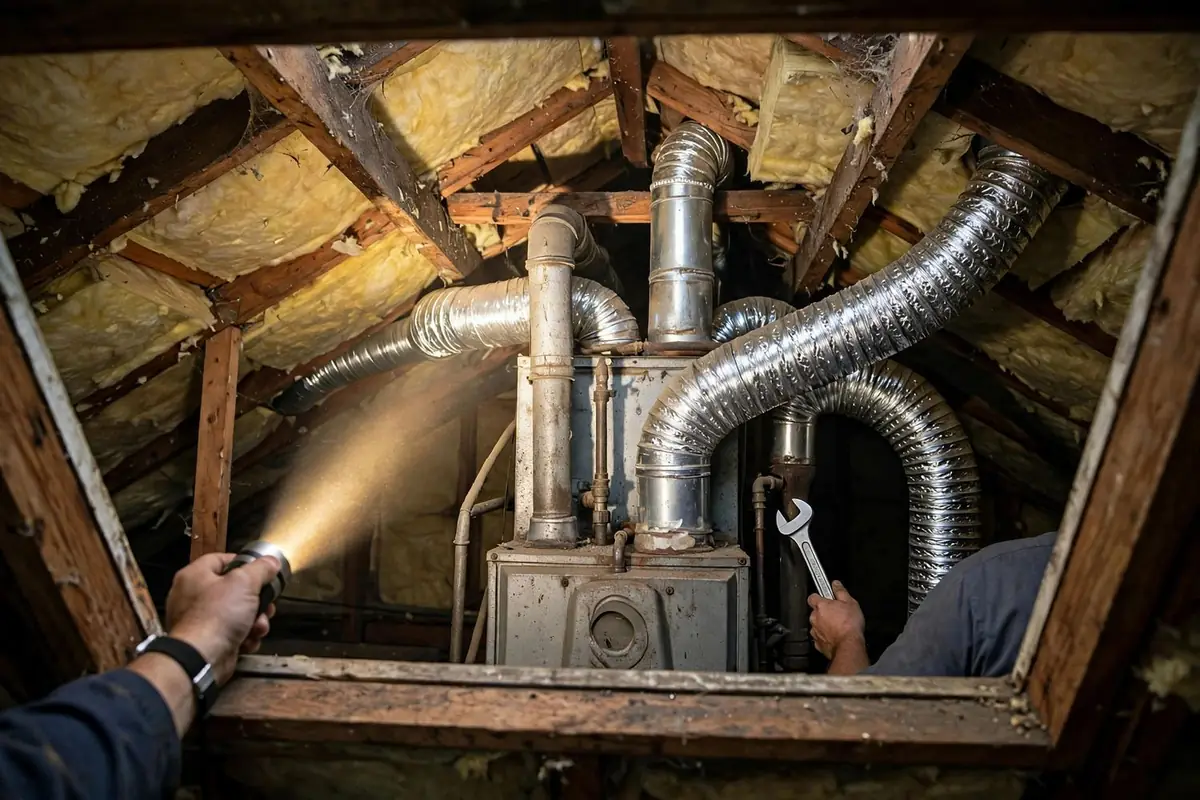
Working in an attic takes more time than working in a garage closet. The tech has to get tools and parts up through the hatch, find solid footing, and work bent over in a tight space. In summer, attic heat limits how long anyone can safely stay up there, so some technicians prefer morning appointments for attic work.
A few things speed up a visit:
- Clear the area under the hatch, and move anything stored on the shelf in a closet hatch.
- Know where the light switch for the attic is, if there is one.
- Tell the person scheduling that the furnace is in the attic, so the right ladder and parts come out on the first trip.
Codes generally call for a clear walkway, a work platform next to the unit and a light in attics with HVAC equipment. Older homes don't always have those, and adding them may become part of a replacement. The cost factors guide explains how access affects the price.
Should you move the furnace out of the attic when you replace it?
Sometimes it's worth asking. Options a contractor may raise:
- Replace it in the same spot. Simplest, usually the least disruptive, and the ducts already connect there.
- Switch to a heat pump. A ducted heat pump air handler can go in the same attic spot, with the outdoor unit replacing the old AC. California's 2025 code uses heat pumps as the baseline for new homes, and many replacements now look at them. See heat pump vs gas furnace.
- Move the equipment to a garage or closet. Easier to service, but it usually means rerouting ducts, gas, venting and wiring.
The attic hatch size matters too. A new furnace has to fit through it, and some old hatches are tight. A contractor will check that during the estimate. Replacing a furnace needs a building permit, and the duct test described above usually applies. See HVAC replacement and the Title 24 permits guide.
When should you call?
Call if you see a ceiling stain under the furnace, water dripping from the secondary drain pipe outside, a system that shuts off and won't restart, airflow that's weak even with a new filter, or any CO alarm. Turn the system off first if water is involved.
RD Heat & Air is a referral line for Fairfield, Vacaville, Suisun City, Benicia, Dixon and Vallejo. Calling (707) 418-4772 connects you with a participating local heating company. Mention that the furnace is in the attic and what you've noticed. If the house simply isn't heating, start with furnace repair.
Sources
- U.S. Census Bureau, American Community Survey 2020–2024 5-year (tables B25003, B25035, B25040), via Census Reporter
- NOAA NCEI, U.S. Climate Normals 1991–2020 (station files for Vacaville, Nut Tree Airport, Fairfield, Vallejo)
- California Energy Commission, Energy Code Support Center: HVAC FAQ
Last reviewed 2026-11-12 by the RD Heat & Air editorial team. Editorial policy.