Why attic ducts leak
Most Solano County homes built in the 1970s through the 1990s run their ducts through the attic. Census ACS data puts the median year built between 1975 in Vallejo and 1988 in Dixon, with Fairfield, Vacaville, Suisun City and Benicia in between. That means a lot of ductwork has been up there for 35 to 50 years.
Attics are hard on ducts. Summer attic air gets far hotter than outdoor air, especially in inland towns. NOAA normals put downtown Vacaville's average July high at 97.3°F before you add roof heat. Years of heating and cooling dry out old tape, loosen connections and make flexible duct jackets brittle.
Then add people. Cable installers, solar crews, insulation contractors and pest technicians all crawl through attics, and it's easy to step on a duct, knock a run loose or crush a flex line. Older installations often used cloth duct tape at joints, which ENERGY STAR specifically warns against because it doesn't last.
How much air do leaky ducts waste?
More than most people guess. ENERGY STAR estimates that in a typical house about 20 to 30 percent of the air moving through the duct system is lost to leaks, holes and poorly connected ducts.
Two kinds of leaks matter:
- Supply leaks blow cooled or heated air into the attic. You paid to condition that air, and the attic gets it.
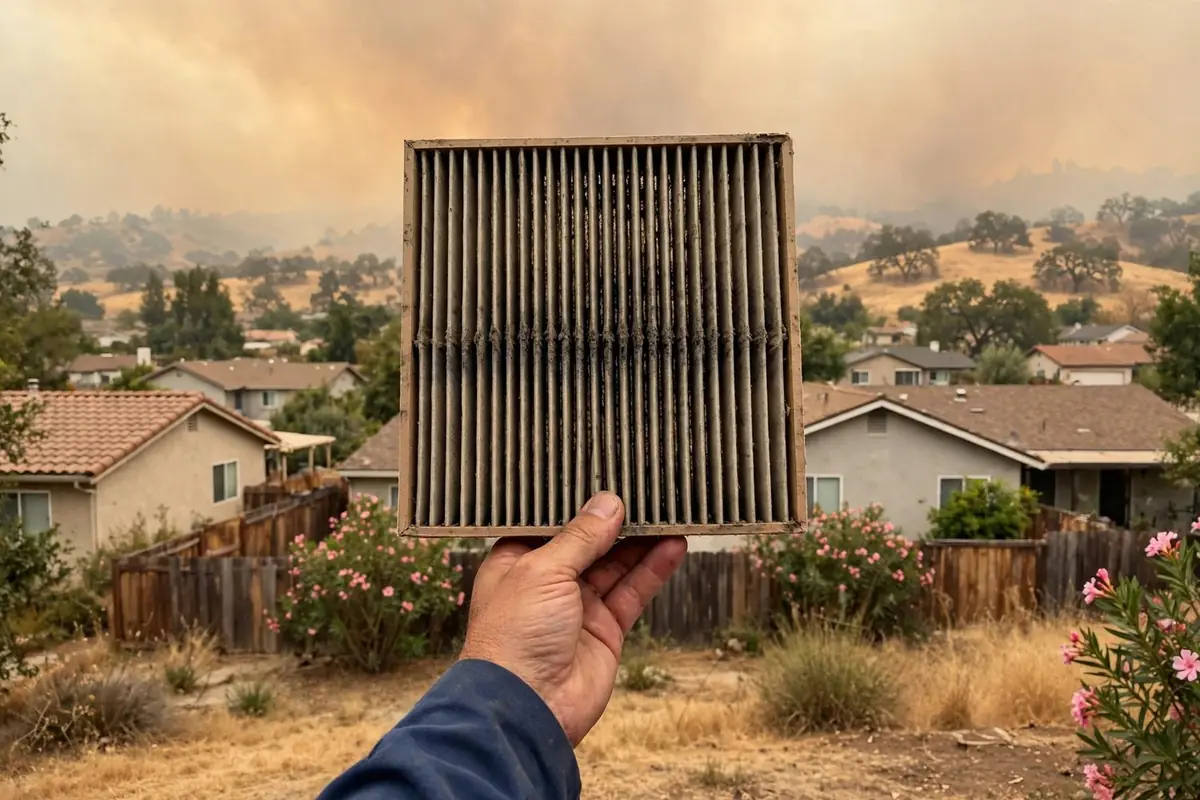
- Return leaks pull air from the attic, garage or wall cavities into the system. In summer that's hot, dusty attic air. During wildfire season it can mean smoky air bypassing the filter.
Both make the system run longer for the same comfort. And a house with big duct leaks can have pressure imbalances that pull outdoor air in through gaps around windows and outlets.
What are the signs of leaky ductwork?
- Some rooms never get comfortable, often the ones farthest from the unit or upstairs.
- Weak airflow at certain vents while others blow hard.
- High summer and winter bills compared with similar homes.
- Dust builds up quickly, or you see dark streaks around ceiling registers.
- The house stays stuffy even when the AC runs a lot.
- Your ducts run through the attic, a crawlspace or the garage.
- Flex ducts in the attic look tangled, kinked, sagging or flattened.
- Smoke or dust smells inside during fire season even with windows closed.
Several of these overlap with other problems, such as a clogged filter or an aging system. If a single room is the issue, start with the hot upstairs guide or the cold room guide.
What you can check without crawling in the attic
Going into an attic on a hot afternoon is genuinely risky: heat exhaustion, nails through the roof deck, and stepping between joists can put a foot through the ceiling. Do these checks from inside the house or from the hatch on a cool morning.
- Look at the gap where each ceiling register meets the drywall. A dark ring of dust usually means air leaking around the duct boot.
- Hold a tissue near a register edge with the fan running. If it flutters at the gap, air is escaping there.
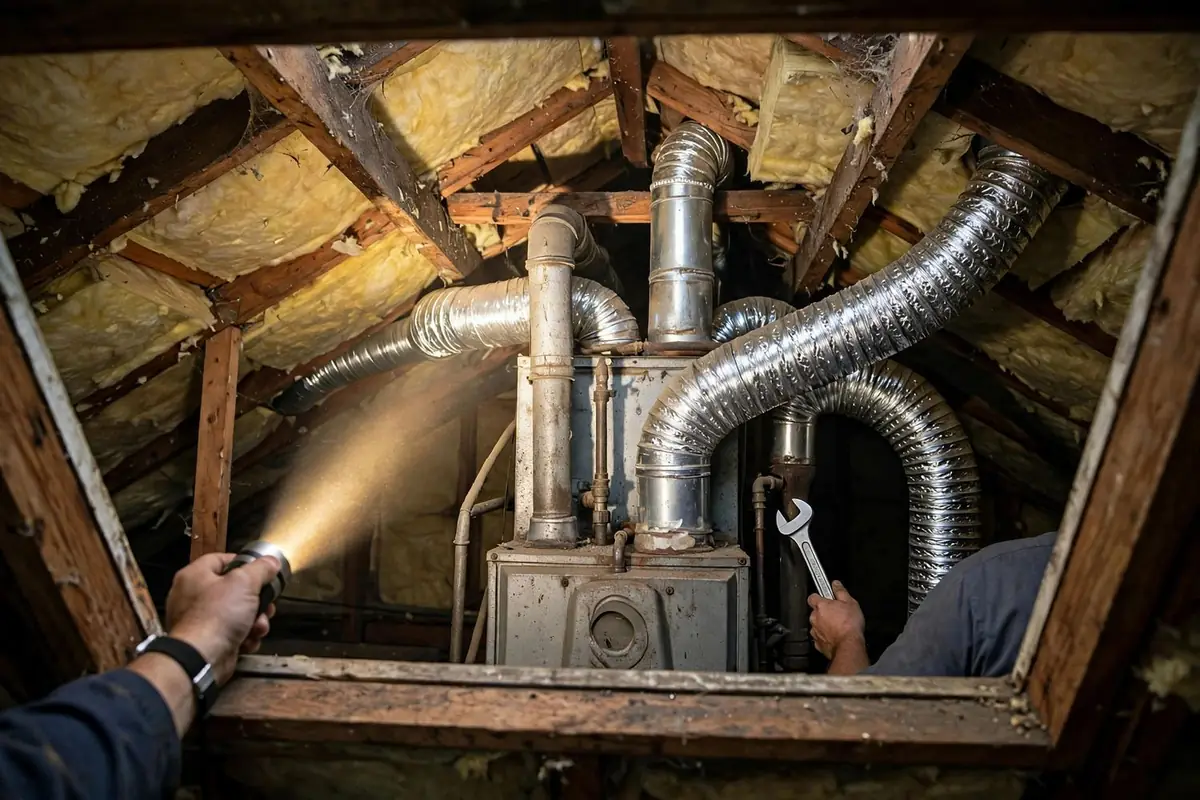
- From the hatch, use a flashlight to look for ducts lying disconnected, crushed under boxes or hanging open.
- Check the return grille in the hall. If you can see gaps where the grille box meets the wall or ceiling, that's a leak pulling attic air.
- Look at the air handler cabinet in the garage or closet for loose panels and missing tape at duct connections.
Snug a loose register cover if you can. For anything inside the attic, call someone who can work there safely.
How duct leakage is tested
Feeling around for leaks only goes so far. A proper test measures them.
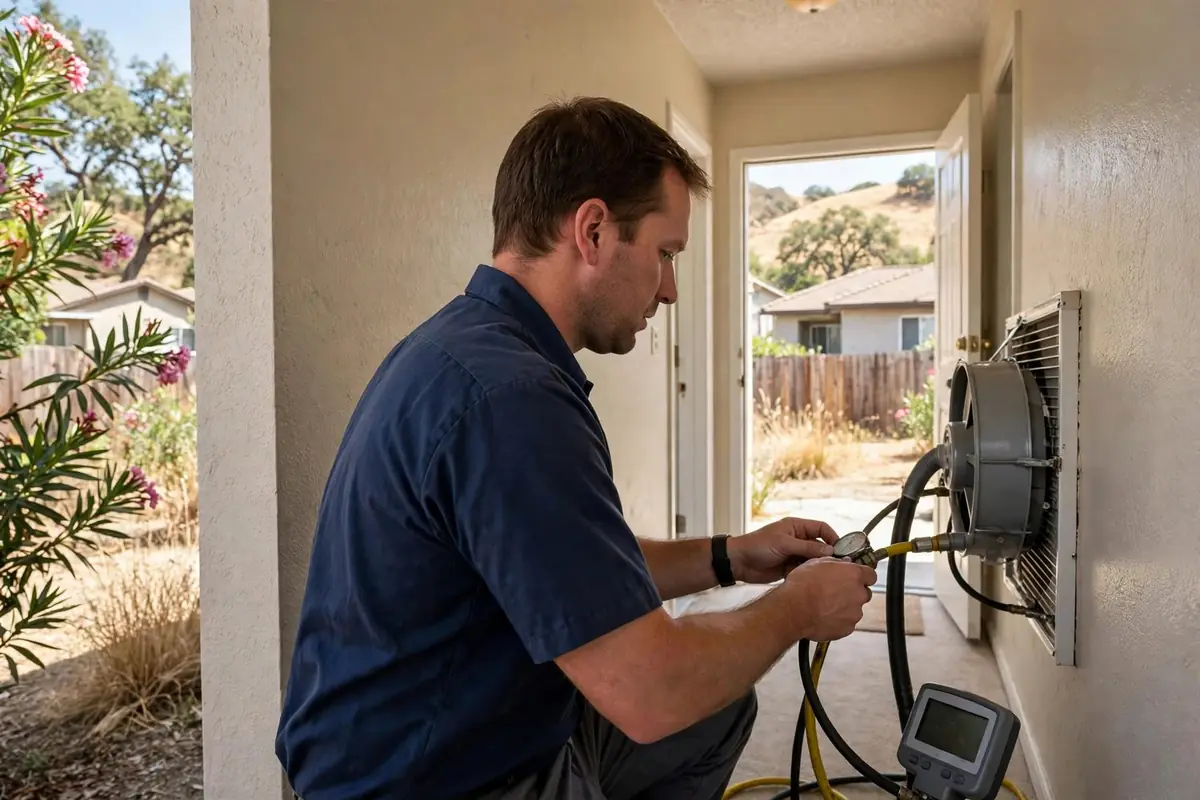
The usual tool is a duct leakage tester: a calibrated fan connected to the duct system, often at the return grille or air handler, with all the supply registers taped shut. The fan pressurizes the ducts to a standard test pressure and measures how much air it takes to hold that pressure. That number, in cubic feet per minute, is the leakage. Compare it to the system's airflow and you get a leakage percentage.
Testers can run two versions:
- Total leakage: all leaks, including ones into the living space.
- Leakage to outside: only leaks to the attic, garage or outdoors, measured by pressurizing the house at the same time.
Some testers also add theatrical smoke to the ducts during the test so leaks show up as wisps in the attic. That's handy for finding where to seal.
What Title 24 requires when you replace a system
California's Energy Code (Title 24, Part 6) has specific duct rules for HVAC change-outs. According to the California Energy Commission's HVAC FAQ:
- Installing a new central heating or cooling system requires a building permit.
- Replacing just the outdoor unit or just the indoor unit of a split system still triggers duct sealing and third-party field verification.
- Under the current Energy Code, existing ducts generally must test at no more than 10 percent total leakage or 7 percent leakage to the outside.
- If the ducts can't reach those targets, an ECC-Rater can verify through a smoke test and visual inspection that accessible leaks have been sealed.
The 2025 code applies to permit applications submitted on or after January 1, 2026. The ECC-Rater is the independent verifier, a role that used to be called a HERS Rater.
In practice this means a permitted replacement includes a duct test. A contractor who offers to skip the permit is also skipping the test that protects your new equipment from leaky ducts. The Title 24 permit guide covers the local permit offices.

How ducts get sealed or replaced
| Approach | When it fits | Notes |
|---|---|---|
| Mastic at joints and boots | Ducts in decent shape with leaky connections | Brush-on paste that cures into a flexible seal. ENERGY STAR recommends mastic or metal tape. |
| Foil or metal tape (UL-listed) | Smaller seams and connections | Better than cloth duct tape, which dries out. |
| Reconnecting and strapping flex runs | Runs that pulled loose or sag | Often found during testing. Proper support keeps flex from kinking. |
| Injected aerosol sealing | Hidden leaks in hard-to-reach ducts | Sealant particles are blown through the ducts and build up at gaps. Ask how it is tested afterward. |
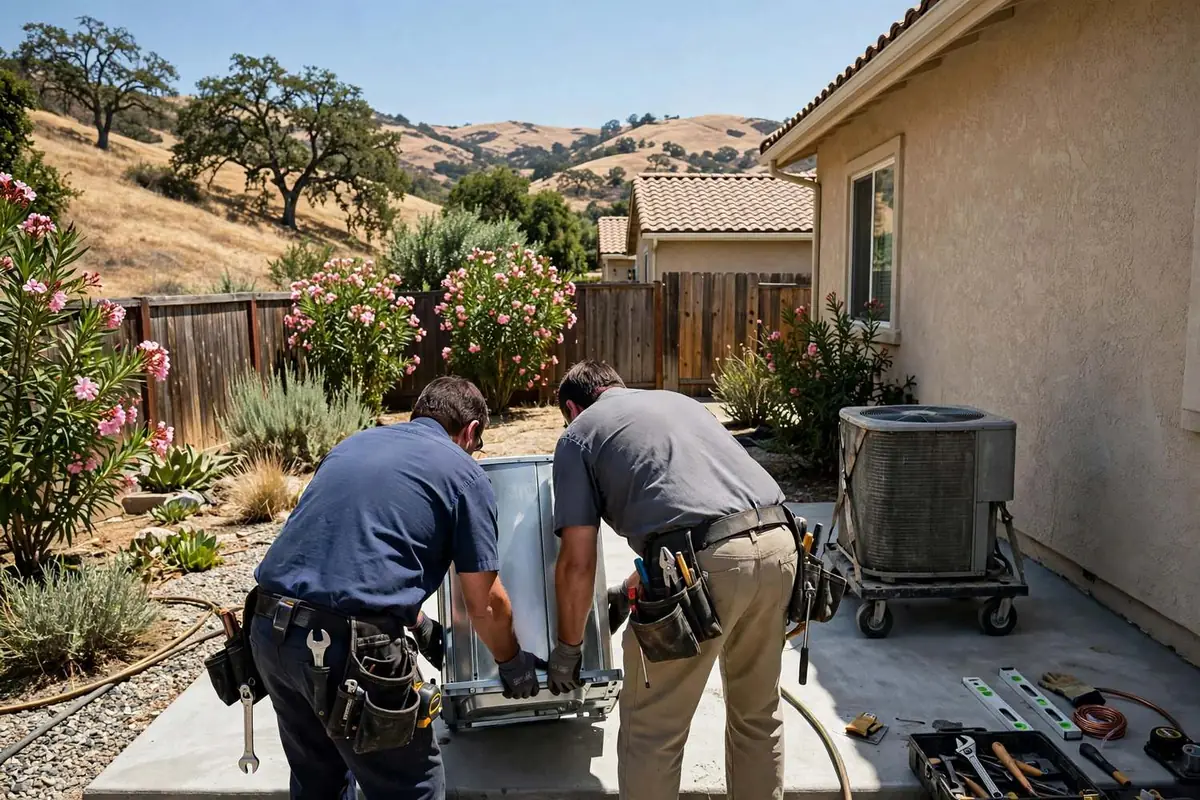
| Replacing sections or the whole system | Brittle, crushed or badly designed ductwork | Gives a chance to fix sizing and add returns. Often done with a new system. |
| Adding or improving insulation | Ducts with thin or damaged insulation | ENERGY STAR recommends insulating ducts in attics and other unconditioned spaces. |
A good duct job ends with a retest so you know the leakage number actually came down. Ask for the before and after readings.
Is duct sealing worth it without a new system?
Often, yes, especially in hot inland neighborhoods. If your system is in decent shape but the house never feels right, sealing and repairing ducts can improve comfort without touching the equipment. It's also good timing before a replacement, since it can affect what size system the house needs.
It may not be worth much if the ducts are mostly inside conditioned space, or if they're so old and badly laid out that replacing them is the better move. A test tells you which situation you're in, so you're not guessing.
Ask about rebates too. Availability changes often. Statewide TECH Clean California single-family heat pump funds were fully reserved in early 2026, but PG&E, MCE (for Fairfield, Benicia and Vallejo customers) and BayREN offers change through the year. Check before you schedule.
Leaky ducts, smoke and dust
Solano County sits in two air districts. Fairfield and Vallejo fall under the Bay Area Air District, while Vacaville and Dixon are in the Yolo-Solano AQMD. Both issue smoke advisories during fire season.
When those advisories hit, a tight duct system and a good filter are part of keeping indoor air cleaner. Return-side leaks undo that by drawing attic or garage air straight into the system without passing through the filter. If your air handler is in the garage, sealed returns also help keep car exhaust and stored chemical fumes out of the house air.
The wildfire smoke guide covers filters and fan settings during smoke events.
Getting your ducts checked
If you see several of the signs above, or you're planning a replacement anyway, ask for a duct leakage test as part of the visit. Ask the company whether they test in-house or bring in an ECC-Rater, what the target number is, and whether they retest after sealing.
RD Heat & Air connects homeowners in Fairfield, Vacaville, Suisun City, Benicia, Dixon and Vallejo with participating local HVAC companies for duct work, repairs and replacements. Call (707) 418-4772.
Sources
- U.S. Census Bureau, American Community Survey 2020–2024 5-year (tables B25003, B25035, B25040), via Census Reporter
- NOAA NCEI, U.S. Climate Normals 1991–2020 (station files for Vacaville, Nut Tree Airport, Fairfield, Vallejo)
- California Energy Commission, Energy Code Support Center: HVAC FAQ
- California Energy Commission, 2025 Energy Code overview
- Bay Area Air District, Solano County
- California Air Resources Board, Yolo-Solano AQMD
- TECH Clean California, Incentives
- MCE, Service area
- BayREN, About
Last reviewed 2026-11-12 by the RD Heat & Air editorial team. Editorial policy.