What does California law require?
The rule comes from the Carbon Monoxide Poisoning Prevention Act of 2010 (Senate Bill 183), now in the California Health and Safety Code starting at section 17926. In plain terms:
- An owner must install a carbon monoxide device in each existing dwelling unit that has a fossil-fuel burning heater or appliance, a fireplace, or an attached garage.
- The device must be approved and listed by the California State Fire Marshal.
- Deadlines have long passed: existing single-family homes had until July 1, 2011, and all other existing dwelling units until January 1, 2013.
- Placement should follow the building standards for new construction or the manufacturer's instructions, where that's technically feasible.
"Fossil fuel" in the law (section 13262) covers coal, kerosene, oil, wood, fuel gases and other petroleum or hydrocarbon products. So a natural gas furnace, a gas water heater, a gas range, a propane heater and a wood-burning fireplace all count. You can read the code text on the state's official site, California Legislative Information.
Does your Solano County home need one?
Almost certainly. About 6 in 10 homes in Fairfield, Vacaville, Suisun City, Benicia, Dixon and Vallejo heat with natural gas, and Benicia is close to 7 in 10 (U.S. Census ACS 2020 to 2024). Even homes with electric heat often have a gas water heater, a gas stove or an attached garage. The 1980s tract homes common in Fairfield and Vacaville nearly all have attached garages.
The only homes that clearly fall outside the rule are all-electric homes with no fireplace and no attached garage. Even then, a CO alarm is cheap insurance if you ever run a generator or a fuel-burning heater.
Where should CO alarms go?
The U.S. Consumer Product Safety Commission advises putting CO alarms on every level of the home and outside sleeping areas, and says interconnected alarms are best because when one sounds, they all do (CPSC CO information center). California's residential building code uses similar placement for new work. A practical plan for a typical Solano house:
- One in the hallway outside each group of bedrooms, close enough to wake people behind closed doors.
- One on each level, including a downstairs living area in a two-story home.
- One in any bedroom that has a fuel-burning appliance in it or in its attached bathroom (some older Vallejo and Benicia homes have wall furnaces in odd spots).
- Consider one near, but not right next to, the door from an attached garage into the house.
- Follow the maker's distance rules for kitchens, bathrooms, furnace closets and fireplaces. Too close and you get nuisance alarms; too far and it may miss a leak.
Don't put a CO alarm inside the furnace closet or right above a gas range. Don't hide one behind curtains or furniture either.

Which type of alarm should you buy?
| Type | Good for | Watch out for |
|---|---|---|
| Plug-in with battery backup | Easy installs near bedrooms | Outlets are often low or behind furniture |
| Battery-only (including sealed long-life) | Hallways with no outlet, rentals | Battery or end-of-life chirps need attention |
| Hardwired with battery backup | Remodels and new work, can be interconnected | Install and wiring changes may need a permit |
| Combination smoke and CO | Fewer devices on the ceiling | The whole unit gets replaced when either sensor ages out |
Whatever you choose, check the package for California State Fire Marshal listing. CO sensors don't last forever. Every alarm has an end-of-life date or warning chirp from the manufacturer; write the install date on the back and replace it when the maker says.
How does your furnace connect to CO?
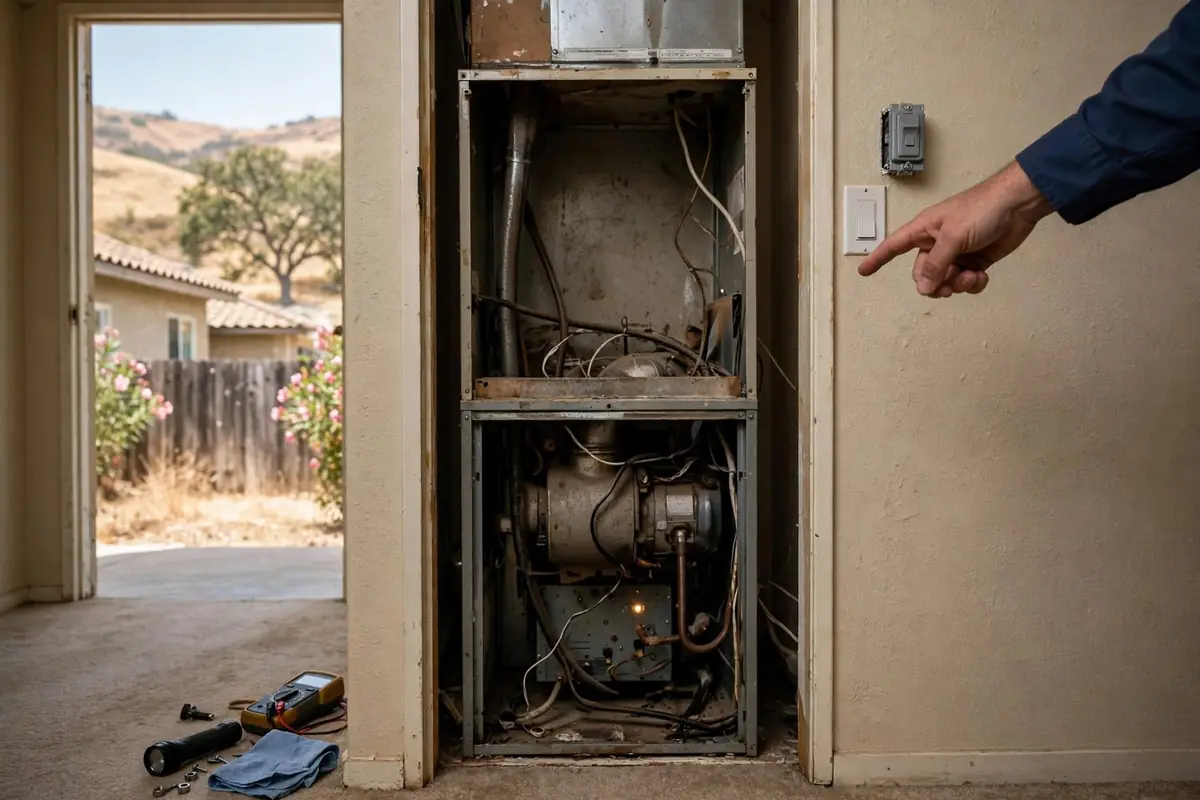
A gas furnace burns natural gas and sends the exhaust, including carbon monoxide, out a vent pipe. Two things keep that exhaust out of your living space: a sealed heat exchanger and a clear, properly sloped vent. When either fails, CO can end up in the house.
Common furnace-related causes:
- A cracked or rusted-through heat exchanger, more likely on older furnaces. See how long furnaces last.
- A blocked or disconnected vent pipe. Birds' nests and storm debris can block a roof vent cap. Attic vent joints can separate.
- Poor combustion from dirty burners or low air supply, especially in a closed-up closet.
- Backdrafting, where exhaust spills back into the house instead of rising up the vent.
Other sources matter too: gas water heaters that share a vent with the furnace, gas ranges used for heat, fireplaces with closed dampers, and cars or generators running in an attached garage.
This is why a yearly furnace check is about more than comfort. A good technician looks at the heat exchanger, the vent, the flame and the draft. The fall furnace checklist lists what that visit should cover.
What to do if a CO alarm goes off
- Get everyone outside to fresh air right away, including pets. Don't stop to open windows or hunt for the source.
- Call 9-1-1 from outside. The fire department has meters to measure CO levels.
- If anyone has symptoms, tell the dispatcher.
- Don't go back in until the fire department says it's safe.
- Before using the furnace again, have a licensed HVAC technician inspect it.
CPSC lists common CO poisoning symptoms as headache, dizziness, weakness, nausea, vomiting, sleepiness and confusion. They're easy to mistake for the flu. A clue that it's CO: several people in the house feel sick at once, and everyone feels better after leaving home.
If you also smell gas, the steps are the same: leave, then call 9-1-1 and PG&E at 1-800-743-5000 from outside. More on smells is on the burning or gas smell page.
What about chirps and false alarms?
A single chirp every minute or so is usually a low battery or an end-of-life warning, not CO. The pattern varies by brand, so read the label on the back. A full, loud alarm pattern (often four beeps and a pause) means the sensor detected CO. Treat that as real until the fire department tells you otherwise.
A "false" alarm right after the furnace starts for the first time in fall is worth taking seriously. A furnace that's been off all summer can have a blocked vent or a combustion problem, and that's exactly when an alarm is doing its job. Honestly, it's better to make a call that turns out to be nothing.
Renters and landlords: who's responsible?
A lot of Solano County households rent. About 43% of Vallejo households and close to 39% in Fairfield and Suisun City are renters (U.S. Census ACS 2020 to 2024), and military families around Travis AFB often rent off base.
Under Health and Safety Code section 17926.1, the owner of a rental must install and maintain CO devices. The tenant is expected to tell the owner or manager if a device is missing, broken or not working. Owners must be allowed reasonable access to check and replace them. If you rent and your alarm chirps or is missing, report it in writing. The Travis AFB HVAC tips guide covers other move-in checks for rentals.
Remodeling or replacing a furnace? Expect an alarm check
California's law has a practical twist. An owner generally doesn't have to upgrade existing CO devices to newer standards until they apply for a permit for alterations, repairs or additions to the home (section 17926.2). That's the moment the building inspector looks at smoke and CO alarms.
A furnace or AC replacement needs a permit in California (see the Title 24 permits guide), so plan for the inspector to check that alarms are in the right places. If you're buying or selling, the standard California seller disclosure form also asks about carbon monoxide devices.
If your alarm sounded, or your furnace is old and you're worried about it, call (707) 418-4772 to connect with a participating local heating company for a safety inspection.
Sources
- U.S. Census Bureau, American Community Survey 2020–2024 5-year (tables B25003, B25035, B25040), via Census Reporter
- PG&E, Gas safety and emergencies
Last reviewed 2026-11-12 by the RD Heat & Air editorial team. Editorial policy.