What does a furnace igniter do?
The igniter is the match. On most gas furnaces built since the 1990s, it's a hot surface igniter: a small ceramic element that glows bright orange when the control board sends power to it. Once it's hot enough, the gas valve opens and the gas lights off the glowing tip.
Older furnaces may use a standing pilot (a small flame that burns all the time) or an intermittent pilot that sparks a pilot flame first and lights the main burners from it. Plenty of 1970s and early 1980s furnaces in Vallejo and Benicia still have one of these setups. The job is the same either way: create a flame when the thermostat calls for heat.
Hot surface igniters are brittle. They crack from age, from thousands of heat-up and cool-down cycles, and sometimes from a single careless touch during service. When one cracks, it may still glow faintly, or it may not glow at all.
What does a flame sensor do?
The flame sensor is the safety check. It's a thin metal rod, usually with a porcelain base, that sits right in the path of one burner flame. When the flame touches it, a tiny electrical current flows through the flame and back to the control board. Technicians measure that current in microamps.
If the board sees that current, it knows the gas is burning and keeps the valve open. If it doesn't, it assumes raw gas is flowing into the furnace with nothing to burn it, and it shuts the valve within seconds. That's exactly what it should do. A flame sensor that "can't see" a perfectly good flame is the most common reason a furnace lights and then quits.
The sensor rarely breaks outright. Far more often it gets coated with a thin layer of oxidation and carbon from years of combustion, plus dust that burns onto it. That coating weakens the signal until the board stops trusting it.
How a gas furnace starts, step by step
Knowing the order helps you figure out where things stop. A typical modern gas furnace goes through this sequence every time it starts:
- The thermostat calls for heat.
- The inducer motor (a small fan) starts to pull air through the burners and push exhaust out the vent.
- A pressure switch confirms the vent is clear.
- The igniter heats up and glows.
- The gas valve opens and the burners light.
- The flame sensor proves the flame.
- After a short delay, the main blower turns on and warm air comes out of the vents.
If the furnace stops at step 4 or 5, the igniter, gas valve or gas supply is the likely problem. If it gets to step 5, lights, and then shuts down a few seconds later, step 6 failed. If it never gets past step 2 or 3, it's probably the inducer, pressure switch or venting, which is a different repair. Some of those failures are covered on the furnace not turning on page.

Igniter or flame sensor: which symptoms point where?
| What you notice | More likely | Why |
|---|---|---|
| You hear the inducer fan, then clicks, but you never hear the whoosh of burners lighting | Igniter (or gas supply) | No glow, no flame |
| Through the sight window, the igniter doesn't glow, or glows dimly in one spot | Igniter | Cracked or worn element |
| Burners light, run for a few seconds, then go out. The furnace tries again | Flame sensor | Board can't confirm the flame |
| Furnace tries several times, then stops and blinks a light code | Either one | Board went into lockout after failed tries |
| Works some mornings, fails others | Flame sensor, sometimes a weak igniter | Signal right on the edge |
| Blower runs but only cold air comes out | Either one, or a lockout | The fan can run without any flame |
The last row trips people up. A furnace that's blowing cold air often has a perfectly fine blower and a failed ignition. The control may keep the fan running to cool the heat exchanger after failed tries, so it feels like the furnace is "on" but broken.
Why these parts act up after a long Solano County summer
Here's the local pattern. Solano furnaces sit for months. Downtown Vacaville averages about 1,677 cooling degree days a year against 2,149 heating degree days, and Fairfield's winters are mild too, with January lows averaging around 40°F (NOAA 1991 to 2020 normals). Many homes don't run the heat at all from April to October.
During that time, dust settles on the burners and the sensor. Then the first cold morning in November arrives, the dust cooks onto the hot parts, and a flame sensor that was barely passing last March doesn't pass anymore. That's why the burning-dust smell and the "lights then quits" call show up in the same week.
Housing age matters as well. The median home in Fairfield was built in 1986 and in Vacaville in 1985 (U.S. Census ACS 2020 to 2024). Plenty of those homes have a second or third furnace by now, but many have attic installs where summer heat bakes wiring and controls for months. A tired igniter that survived last winter can crack on its first cycle of the season.
About 6 in 10 homes in these cities heat with natural gas, so this is one of the most common heating calls in the county once the weather turns.
What you can safely check before you call
- Thermostat is set to Heat, and set a few degrees above the room temperature.
- Thermostat batteries are fresh (a blank or dim screen is a clue; see thermostat blank).
- The furnace switch (it looks like a light switch, on or near the unit) is on.
- The breaker for the furnace hasn't tripped.
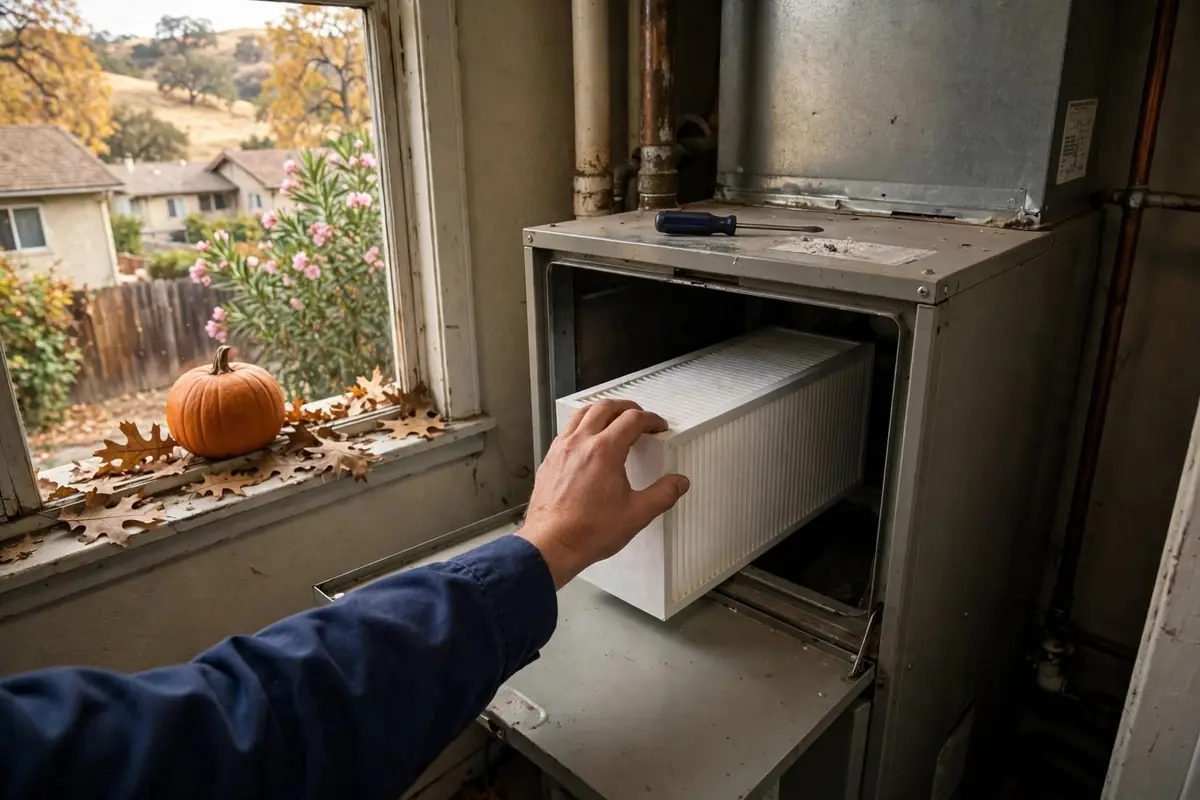
- The filter isn't clogged. A badly blocked filter can make the furnace overheat and shut down, which looks a lot like an ignition problem.
- The front door panel is fully seated. Most furnaces have a door switch that cuts power if the panel is loose.
- Look through the small sight window on the door, if yours has one, and note the blink pattern of the status light. The code chart is usually printed on a label inside or on the door.
Then reset once. Turn the furnace switch off, wait about a minute, and turn it back on. Watch and listen through one full start attempt. If it fails again the same way, stop there. Repeated resets won't fix a cracked igniter or a dirty sensor, and you'll just put the control back into lockout.

Should you clean the flame sensor yourself?
You'll find plenty of videos showing people pulling the flame sensor and rubbing it with a fine abrasive pad. Honestly, it's often the right fix. It's still a job for a technician, for a few good reasons.
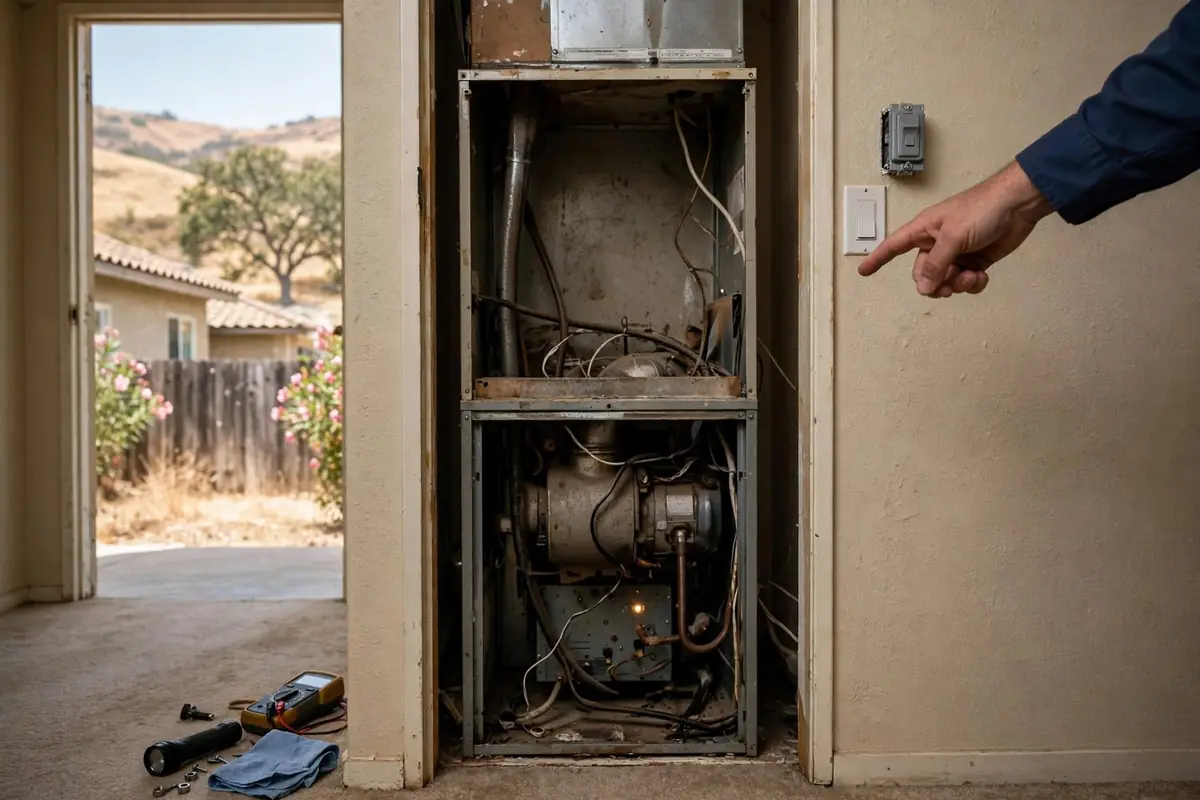
The sensor sits inside the burner compartment, next to the gas manifold and the igniter. Getting to it means removing panels that are there for a reason, working around a part that cracks if you bump it, and putting everything back with the right seal and grounding. A furnace that lights and then shuts off can also have other causes, like a poor ground, low gas pressure or a cracked porcelain base, that cleaning won't touch.
The bigger issue is safety. A furnace that keeps failing to prove flame is telling you something about combustion. A trained tech checks the flame pattern, the venting and the gas pressure at the same visit. Keep your side of the job to the checks above.
What the technician does on an ignition call
A good ignition diagnosis is quick and specific. Expect the technician to:
- Read the control board's fault code and watch a full start sequence.
- Check the igniter for cracks and test it with a meter.
- Measure the flame sensor signal in microamps, then clean or replace the sensor if it's weak.
- Confirm the furnace is properly grounded, since the flame signal depends on it.
- Check gas pressure and look at the flame pattern.
- Look at the inducer, pressure switch and vent if the sequence stalls earlier.
Ask what the microamp reading was before and after. Ask whether the igniter is the original. If it's the original on a furnace that's 15 or more years old, it may be worth asking about the overall condition of the furnace too, which is covered in how long furnaces last.
Cost depends on the part, your furnace brand, access (attic and crawlspace installs take longer) and when you call. The repair cost factors guide explains what moves the price without quoting numbers.
When an ignition problem becomes a safety problem
Most igniter and sensor failures are annoying, not dangerous. The furnace's safety controls are doing their job by shutting down. A few signs change that:
- You smell gas (a rotten-egg or sulfur smell). Don't flip switches or try another reset. Leave the house, then call 9-1-1 and PG&E at 1-800-743-5000 from outside.
- You hear a loud bang or boom when the burners light. Delayed ignition can mean gas is building up before it lights. Shut the furnace off at the switch and call.
- A carbon monoxide alarm sounds. Get everyone outside and call 9-1-1.
- You see scorch marks on the furnace cabinet or smell hot plastic.
The burning or gas smell page walks through those smells in more detail. If none of them apply and you're just cold, it's a normal repair call. Call (707) 418-4772 and the line connects you with a participating local heating company.
How to keep it from happening next November
The best fix is boring: have the furnace checked in early fall, before you need it. A fall visit is when a technician can clean a weak flame sensor and spot a cracked igniter before the first cold snap, when phones get busy. The fall furnace checklist lists what to do yourself and what to leave for the tech.
Change the filter before the first heating day, too. A clean filter keeps dust off the burners and keeps the furnace from overheating. If you're in Vacaville and want help finding someone local, see furnace repair in Vacaville, or Fairfield on the other side of the hill.
Sources
- NOAA NCEI, U.S. Climate Normals 1991–2020 (station files for Vacaville, Nut Tree Airport, Fairfield, Vallejo)
- U.S. Census Bureau, American Community Survey 2020–2024 5-year (tables B25003, B25035, B25040), via Census Reporter
- PG&E, Gas safety and emergencies
Last reviewed 2026-11-12 by the RD Heat & Air editorial team. Editorial policy.