The short version
For most Solano County homes replacing both heating and cooling at once, a heat pump is a strong choice. The winters here are gentle, the summers are hot, and a heat pump handles both with one outdoor unit. A gas furnace with a separate AC is still a reasonable choice in some homes, especially if your AC is only a few years old or your electrical service can't easily take more load.
The right answer depends more on your house than on the technology. The sections below walk through what matters here specifically.
How each system works
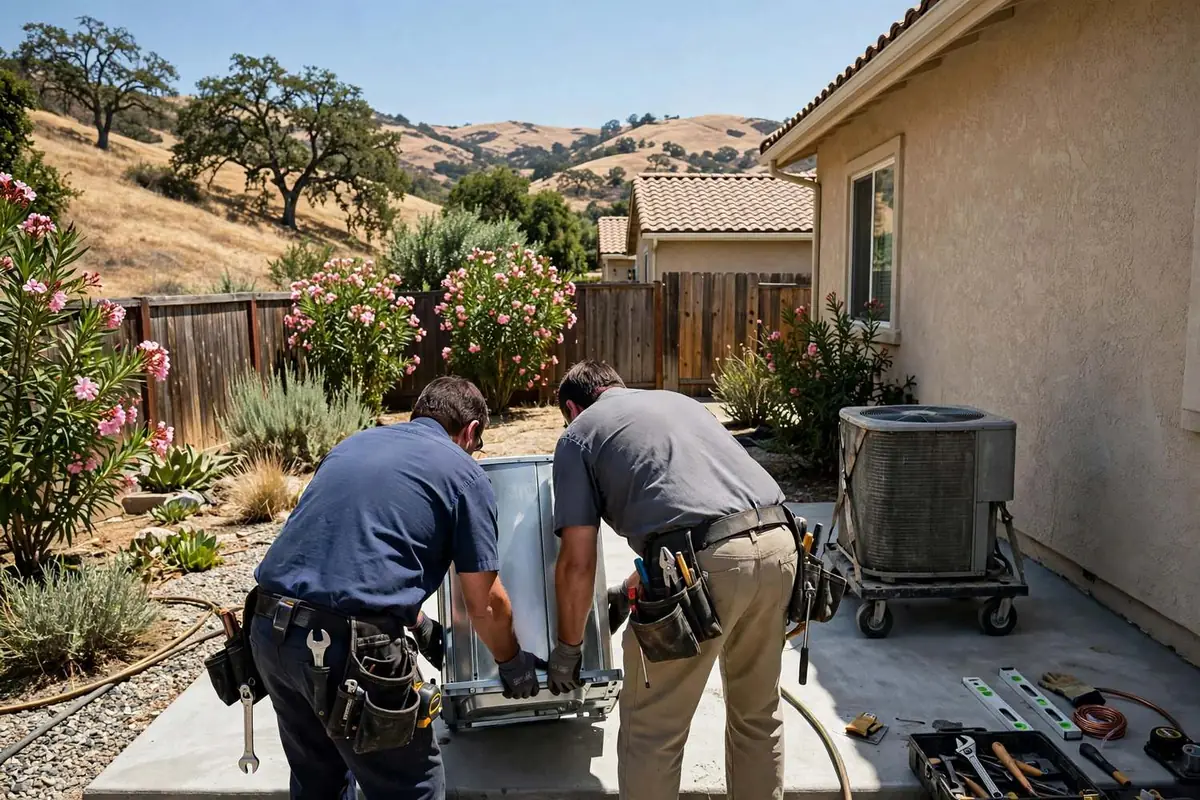
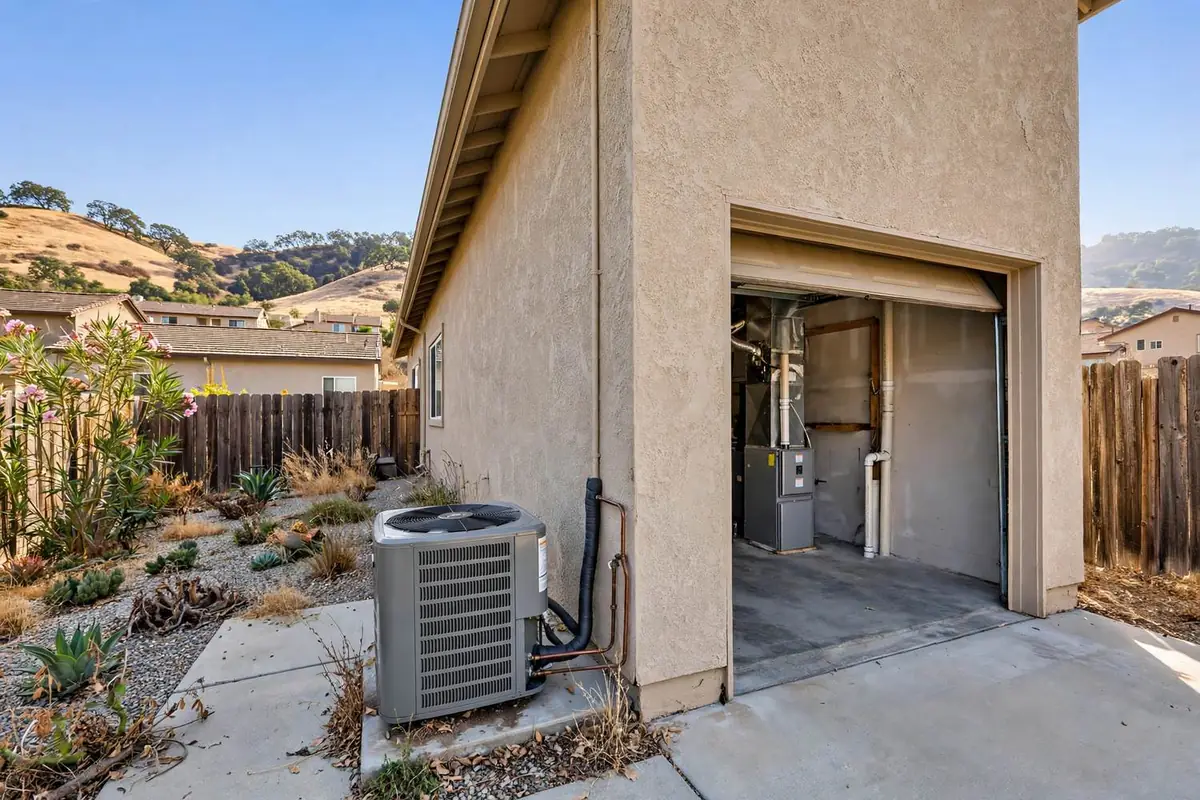
A gas furnace burns natural gas and blows air across a hot heat exchanger. It only heats. Cooling comes from a separate air conditioner whose outdoor unit sits on a pad outside and whose coil sits on top of the furnace.
A heat pump is basically an air conditioner that can run in reverse. In summer it pulls heat out of the house. In winter it pulls heat from the outdoor air and moves it inside, even when the air feels cold. Indoors, it uses an air handler with a blower and usually electric backup heat strips. The aux and emergency heat post explains how that backup works.
Both systems use your existing ducts in a typical Solano home. Ductless mini-splits are not covered by this phone line; they're a separate category.
Why the local climate favors heat pumps
Heat pumps work best when winters are mild, and Solano County's are. January lows average about 40°F in Fairfield and Vacaville and about 42°F in Vallejo. Freezing nights are uncommon: roughly 14 a year in downtown Vacaville, 8 in Fairfield and 4 or 5 in Vallejo (NOAA 1991 to 2020 normals).
The U.S. Department of Energy notes that standard air-source heat pumps lose heating efficiency below about 35°F and may need backup heat (DOE heat pump guidance). Here, that's a handful of early mornings a year, not a whole season.
Summer is the bigger load in the inland towns. Downtown Vacaville averages 1,677 cooling degree days a year and a July high of 97.3°F. Fairfield runs 1,113 cooling degree days and Vallejo 868. Whatever you install has to cool well on a 105°F afternoon in Vacaville. A heat pump is an air conditioner, so you're not giving anything up on cooling. Size matters a lot more in Vacaville and Dixon than in Vallejo or Benicia, where the Delta breeze keeps summer milder.
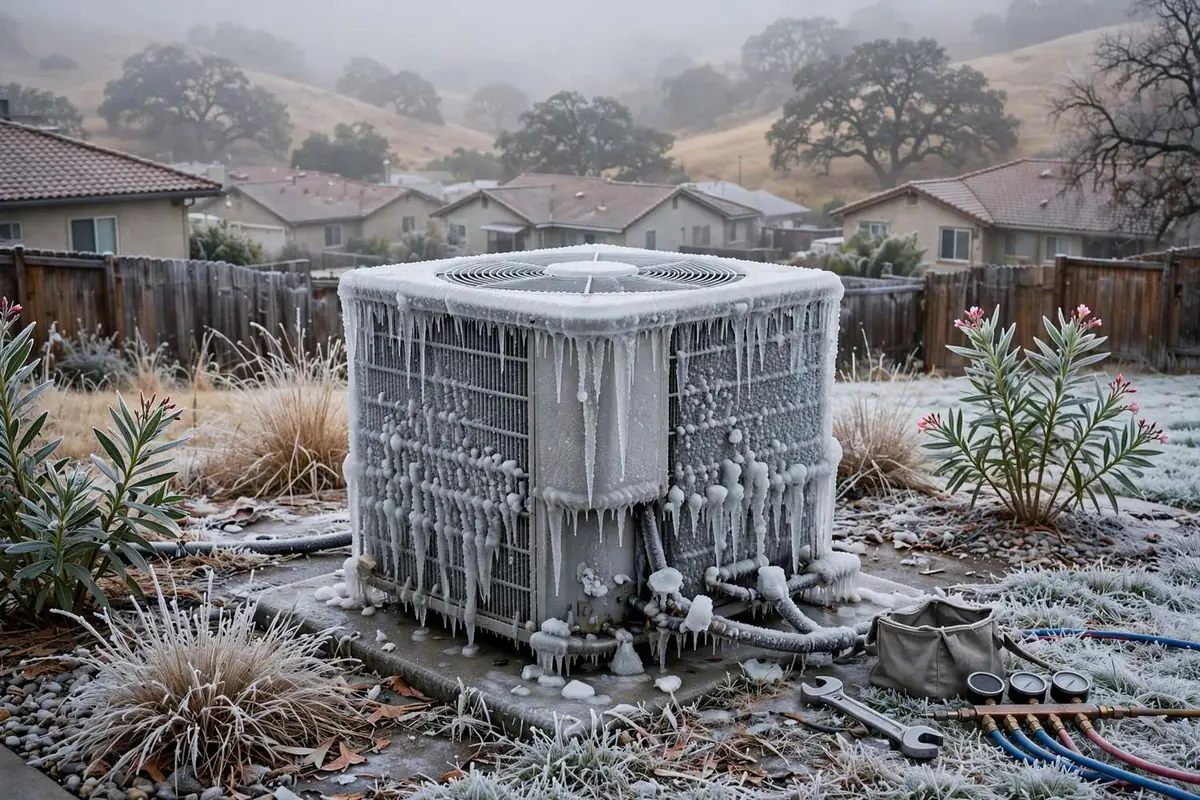
Heat pump vs gas furnace: side by side
| Heat pump | Gas furnace + AC | |
|---|---|---|
| Heats and cools | One system does both | Two pieces of equipment |
| Winter comfort | Steady, gentler warm air | Hotter air from the vents, fast warm-up |
| Fuel | Electricity only | Gas for heat, electricity for cooling and the blower |
| Combustion and CO risk | None from the heat pump | Needs venting checks and CO alarms |
| Electrical needs | May need panel or circuit upgrades | Usually works with existing service |
| Bay Area air rule (2029) | Not affected | New furnaces must be zero-NOx in BAAQMD cities |
| Running cost | Depends on your electric rate plan and how much backup heat runs | Depends on gas rates, plus AC electricity in summer |
| Good fit when | Heating and AC both need replacing | AC is newer, panel is maxed out, or you want gas backup |
Running costs swing with PG&E's gas and electric rates, your rate plan and your house. Ask any company quoting the job to explain the operating cost for your home, not a national average.
What the Bay Area air rule means for furnaces
If you live in Fairfield, Suisun City, Benicia or Vallejo, you're in the Bay Area Air District. Its amended Rule 9-4, adopted in March 2023, sets a zero-NOx emission standard for new natural gas furnaces. Starting in 2029, the furnaces sold or installed in the district have to meet it, which in practice points toward heat pumps (BAAQMD building appliance rules).
Three things to know:
- It doesn't force you to replace a working furnace. The rule applies when equipment is replaced.
- The district has been revising the timing and exemptions. In November 2026 it delayed the related water heater rule to 2028. Check the district's page for the current furnace date before you decide.
- Vacaville and Dixon are in the Yolo-Solano air district instead, so the Bay Area rule doesn't apply there.
If your furnace is 15 years old in Fairfield, this is worth factoring in. A gas furnace installed now could easily still be running long after 2029, which is fine, but your next replacement would face the rule.
Title 24, permits and what changes on install day
Either way, a replacement needs a city building permit. The California Energy Commission says installing a space-conditioning appliance other than a plug-in room unit requires one, and changing out the indoor or outdoor unit of a split system triggers duct sealing and third-party field verification (CEC HVAC FAQ).
A few heat-pump-specific points from the same source:
- Refrigerant charge verification is required for heat pumps in every climate zone.
- Most of Solano County is in climate zone 12; central Vallejo falls in coastal zone 3.
- The 2025 Energy Code applies to permits applied for on or after January 1, 2026, and it treats heat pumps as the baseline for new homes.
The Title 24 permits guide covers the duct test and inspection in plain language. New heat pumps and ACs also now use lower-GWP refrigerants under EPA rules; the refrigerant changes guide explains what that means for you.
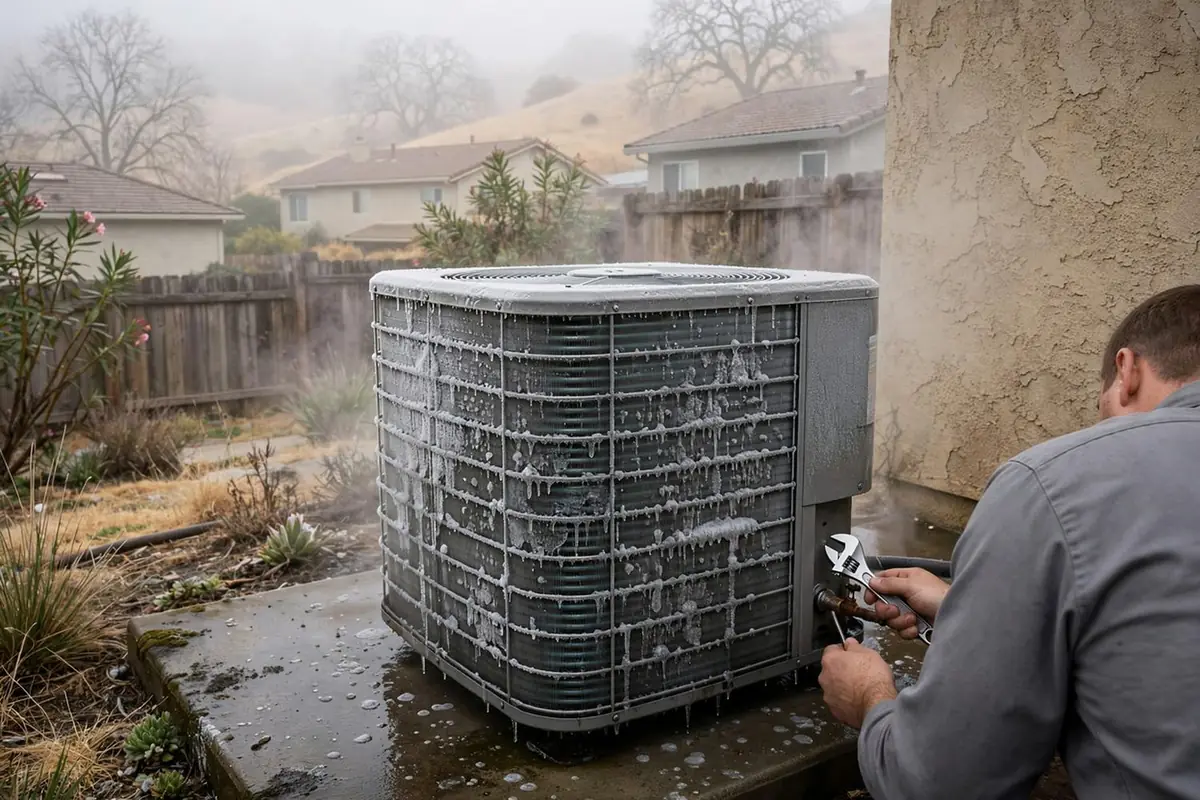
Is your house ready for a heat pump?
Questions to ask before you choose:
- How big is your electrical panel, and does it have room for the heat pump and backup strips?
- Are your ducts in decent shape? Leaky attic ducts hurt a heat pump more because its supply air is gentler.
- How old is your current AC? If it's under about 8 years, a furnace-only swap may make more sense for now.
- Do you want gas backup? A dual-fuel system pairs a heat pump with a gas furnace.
- Will the outdoor unit location work for noise and airflow?
- Is attic insulation reasonable? Many homes built in the late 1970s and 1980s could use more.
Housing age matters here. Median build years run from 1975 in Vallejo to 1988 in Dixon (U.S. Census ACS 2020 to 2024). Older homes are more likely to have smaller panels and original ducts, which a good estimate should address. The how to choose an HVAC company guide has questions for comparing quotes.
What about rebates?
Rebate availability changes often. Statewide TECH Clean California single-family heat pump incentives were fully reserved as of February 24, 2026, with new reservations waitlisted (TECH Clean California). Solano County is a BayREN member county, and MCE serves Fairfield, Benicia and Vallejo with its own programs. PG&E offers change over time too.
Ask every company quoting the job which programs they participate in today. The heat pump rebates guide keeps track of what's open.
So which should you choose?
Here's a practical way to decide:
- Your furnace and AC are both old or failing: get a heat pump quote. In this climate it's usually the strongest option, and in Bay Area Air District cities it also gets you ahead of the 2029 rule.
- Your furnace failed but your AC is fairly new: a furnace replacement is often the practical move, and you can switch to a heat pump when the AC wears out.
- Your panel is small and an upgrade is a big job: compare a dual-fuel system or a furnace, and ask the electrician-side questions early.
- You're in Vacaville or Dixon: cooling performance matters most. Make sure the system is sized with a real load calculation, not a rule of thumb.
For help getting quotes, see HVAC replacement, or call (707) 418-4772 to connect with participating local companies that install both furnaces and heat pumps.
Sources
- NOAA NCEI, U.S. Climate Normals 1991–2020 (station files for Vacaville, Nut Tree Airport, Fairfield, Vallejo)
- U.S. Census Bureau, American Community Survey 2020–2024 5-year (tables B25003, B25035, B25040), via Census Reporter
- California Energy Commission, Energy Code Support Center: HVAC FAQ
- California Energy Commission, 2025 Energy Code overview
- Bay Area Air District, Solano County
- TECH Clean California, Incentives
- BayREN, About
- MCE, Service area
Last reviewed 2026-11-12 by the RD Heat & Air editorial team. Editorial policy.