What counts as short cycling?
On a hot afternoon a healthy central AC should run long, steady stretches. In mild weather it cycles more often, and that's fine. Short cycling is different. The outdoor unit kicks on, runs a short time, stops, and starts again soon after, all while the house never quite reaches the setpoint.
You will often hear it before you notice the temperature. A click from the thermostat, the outdoor fan spinning up, then quiet, then the same thing again.
It's worth taking seriously. Every start is the hardest moment for a compressor, and a system that starts constantly wears out faster, cools poorly and leaves the air damp.
If your problem is the furnace rather than the AC, the causes are different. See furnace short cycling instead.
How do you confirm it?
Before you start changing things, spend fifteen minutes watching. It makes the rest of this easier.
- Note the indoor temperature and the setpoint.
- Time a few run cycles with your phone. Write down how long it runs and how long it rests.
- Go outside during a run. Is the outdoor fan spinning? Is the unit humming steadily or buzzing?
- Check whether the indoor blower keeps running when the outdoor unit stops.
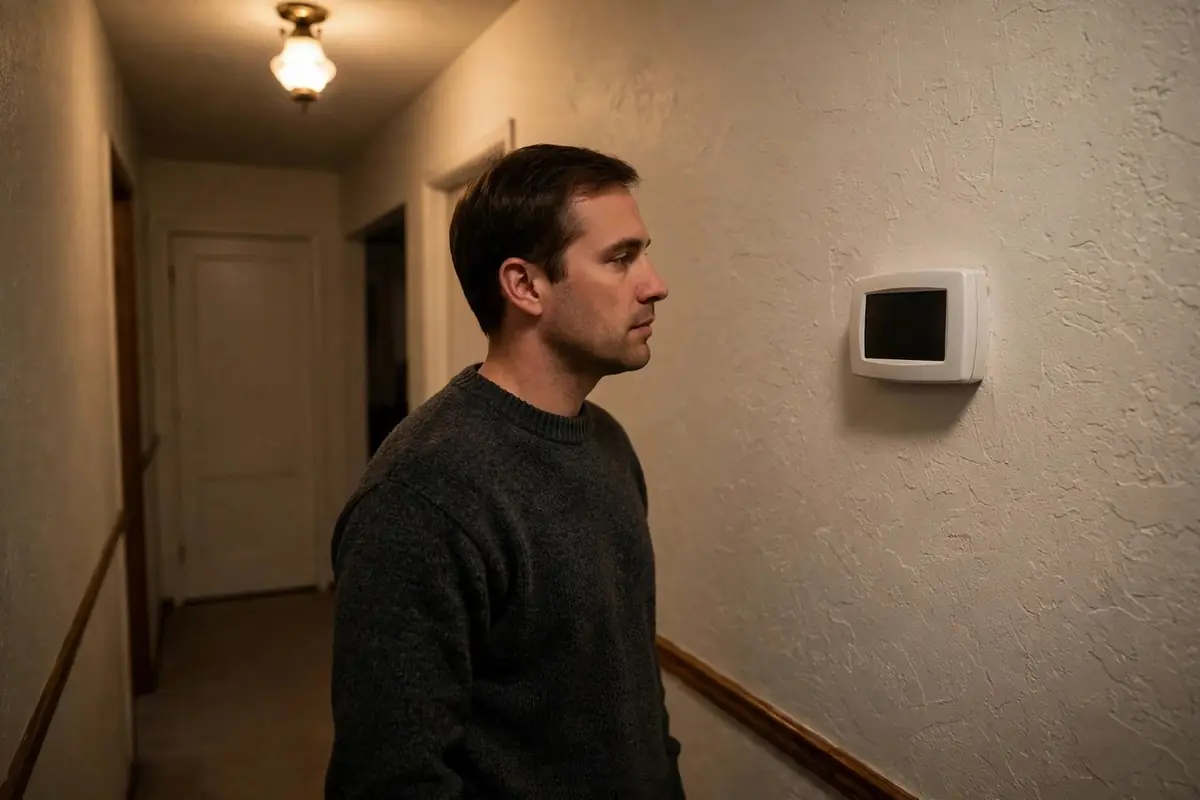
- Look at the thermostat screen. Does it show "cool on" the whole time, or does the call for cooling drop?
That last point matters a lot. If the thermostat stops calling for cooling, the thermostat side is the suspect. If the thermostat still calls for cooling and the outdoor unit quits anyway, a safety switch or electrical part outside is stopping it.
Common causes and what each one looks like
| What you notice | Likely cause | Who handles it |
|---|---|---|
| Filter is gray and packed, airflow weak | Restricted airflow, coil starting to freeze | You (replace filter), technician if ice forms |
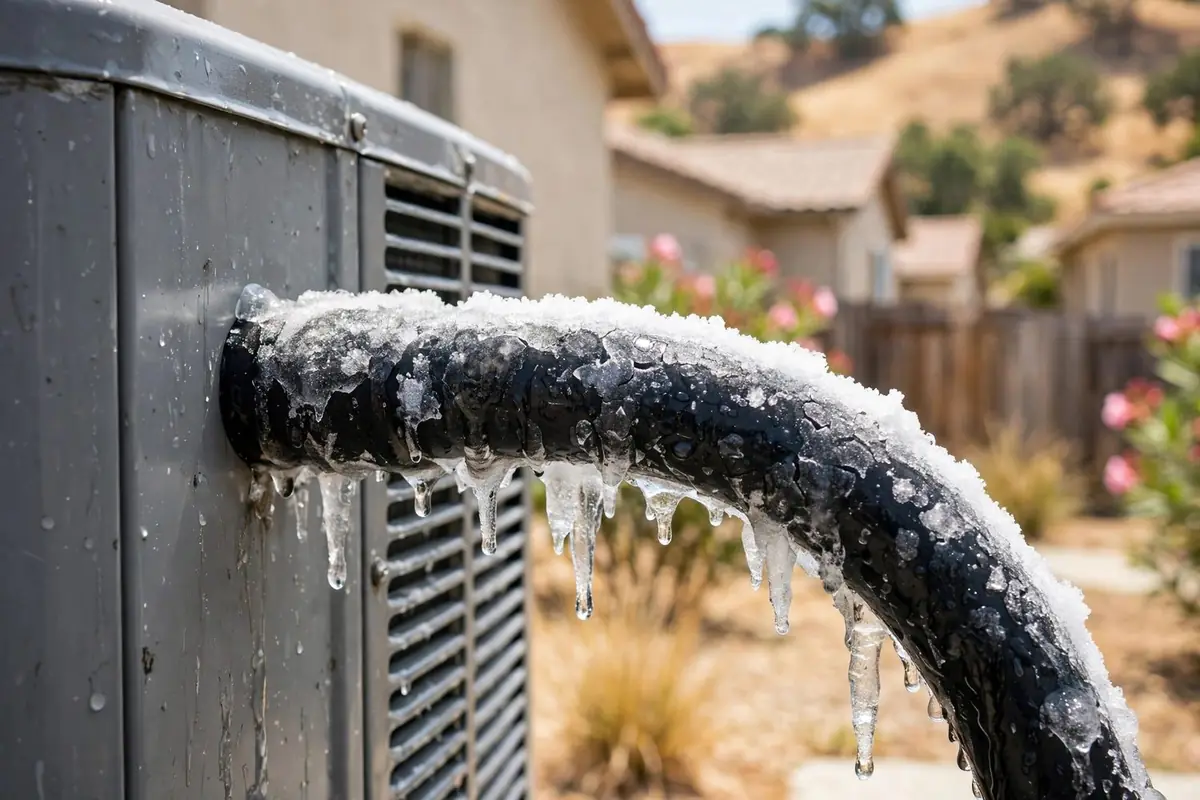
| Ice on the copper line or indoor coil | Low airflow or low refrigerant | Technician |
| Thermostat near a supply vent, sunny window or kitchen | Thermostat reads the wrong air | Technician or electrician to relocate |
| Thermostat screen flickers or resets | Weak batteries or a loose wire | You (batteries), technician (wiring) |
| Water in the drain pan or a float switch tripped | Clogged condensate line | You (clear the drain if accessible), technician if it returns |
| Outdoor coil matted with dust or grass | High pressure trips on hot afternoons | You (gentle rinse), technician (deep clean) |
| Outdoor unit hums, fan slow or stops | Weak capacitor or failing fan motor | Technician only |
| Short runs started right after the system was installed | Oversized unit or setup problem | Installing contractor |
Is the air filter or a frozen coil to blame?
Start here. It takes two minutes and it's the most common culprit.
A clogged filter cuts the air moving across the indoor coil. The coil gets colder and colder until moisture on it turns to ice. Ice blocks more air, pressures drop, and a low-pressure safety switch can shut the outdoor unit down. When it warms back up, the system tries again. Short cycle.
Replace the filter if you can't see light through it. If you see ice on the large copper line or the indoor unit, set the thermostat to off, set the fan to on and let it thaw for several hours before trying cooling again. The frozen AC page walks through thawing. If the ice comes back with a clean filter, the next suspect is low refrigerant, and that needs a technician.
Could the thermostat be causing it?
More often than people expect. A thermostat only knows the air right around it.
Put it next to a supply vent and it gets blasted with cold air, decides the house is cool and shuts the system off early. Put it in afternoon sun or near the oven and you get the reverse problem plus some odd cycling. Many 1980s and 1990s tract homes across Fairfield and Vacaville have the thermostat in a hallway, which is usually fine, but remodels sometimes add a vent or a skylight nearby.
Things to try:
- Replace the batteries, even if the screen looks okay.
- Check the settings. Some smart thermostats have a "cycle rate" or "cycles per hour" setting that may have been changed.
- Remove the cover and look for dust or a wire pulled loose. Look only; don't move wires around.
- Close a nearby vent temporarily and see if the cycles get longer.
If the screen goes blank, the blank thermostat guide covers that.
Is a full condensate drain shutting it off?
Your AC pulls water out of the air as it cools. That water drains through a pipe, often into the garage, outside or a nearby drain. Many systems, especially attic and closet units, have a float switch that cuts power to the AC when water backs up. The point is to stop a ceiling leak. The side effect can look like short cycling: water rises, the switch opens, water drains a bit, the switch closes, the AC starts again.
This shows up more in humid stretches. Homes near the Suisun Marsh, which covers roughly 116,000 acres of wetland next to Suisun City and south Fairfield, see more moisture in the air on some summer days than homes up in dry Dixon. More moisture means more water through the drain and more chance a slow clog backs up.
If you can reach the drain line's cleanout or the outdoor end, clear it gently. A wet-dry vacuum on the outdoor end works for many homes. Don't open sealed electrical boxes. The AC leaking water page has step-by-step drain checks.
Why heat waves make short cycling worse
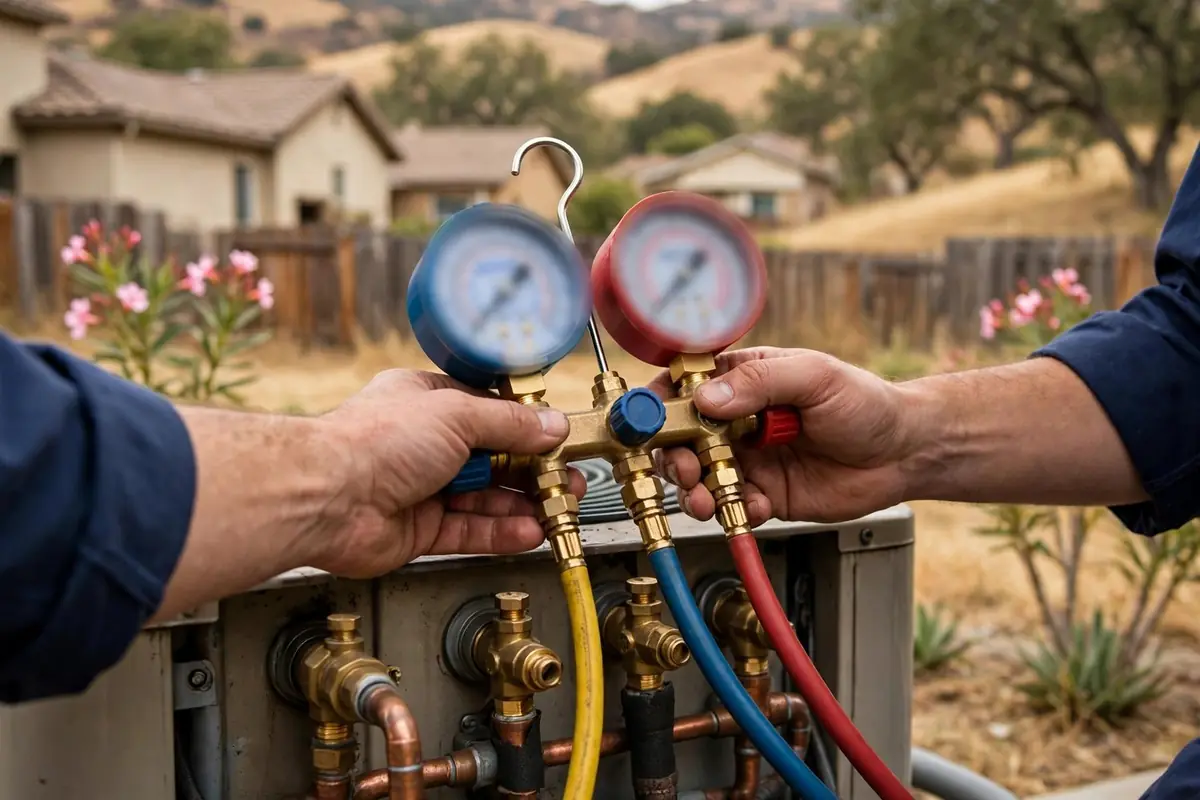
Inland Solano County gets hot. NOAA's 1991 to 2020 normals put downtown Vacaville at about 28 days a year of 100°F or hotter, and Fairfield at about 11. On those afternoons, the outdoor coil is working hard to get rid of heat.
If that coil is coated with dust, cottonwood fluff, dried grass or dog hair, it can't shed heat fast enough. Pressure inside climbs, and a high-pressure switch or the compressor's internal overload can trip to protect it. The unit stops, cools down a bit, then restarts. You see a system that works fine in the morning and short cycles at 4 p.m.
Weak capacitors fail in the same conditions. A capacitor that's starting to go might start the compressor on a cool morning and struggle on a hot afternoon. That part stores a dangerous electrical charge even with the power off, so leave it to the technician.
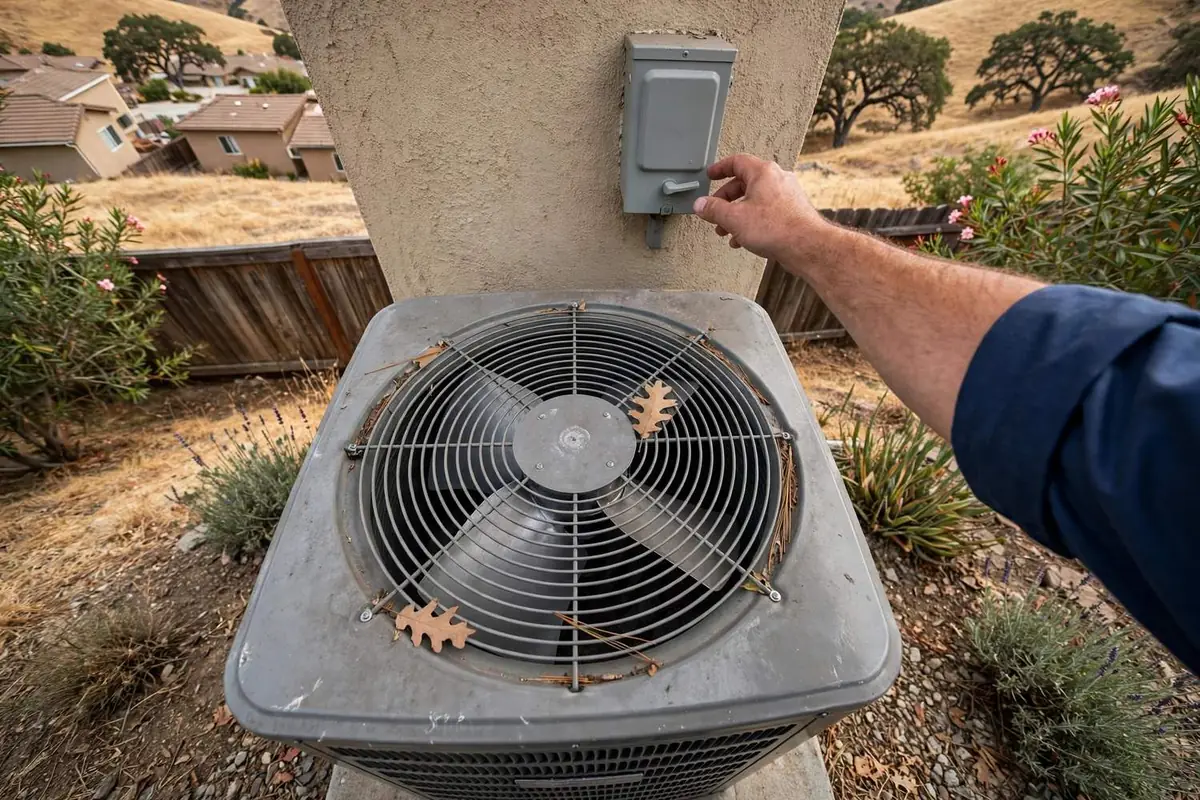
A safe step for you: turn the AC off at the thermostat and the outdoor disconnect, then rinse the outdoor coil gently with a garden hose. No pressure washer, and don't bend the fins. The heat wave AC plan covers more prep.
Can an oversized AC short cycle?
Yes. A system with far more capacity than the house needs cools the air near the thermostat in a few minutes and shuts off. The far rooms never catch up, and the coil never runs long enough to pull out much humidity, so the house feels cool and clammy.
The telltale is timing. If short cycling has happened since the day the unit was installed, especially in mild weather, oversizing or a setup problem is likely. If it started recently on a system that used to run fine, the unit didn't grow. Something changed, and it's usually one of the causes above.
Fixing true oversizing can mean adjusting the blower settings, changing the thermostat setup, or, at replacement time, choosing the right size based on a load calculation. Read the AC sizing guide for how that works.
Low refrigerant and electrical problems
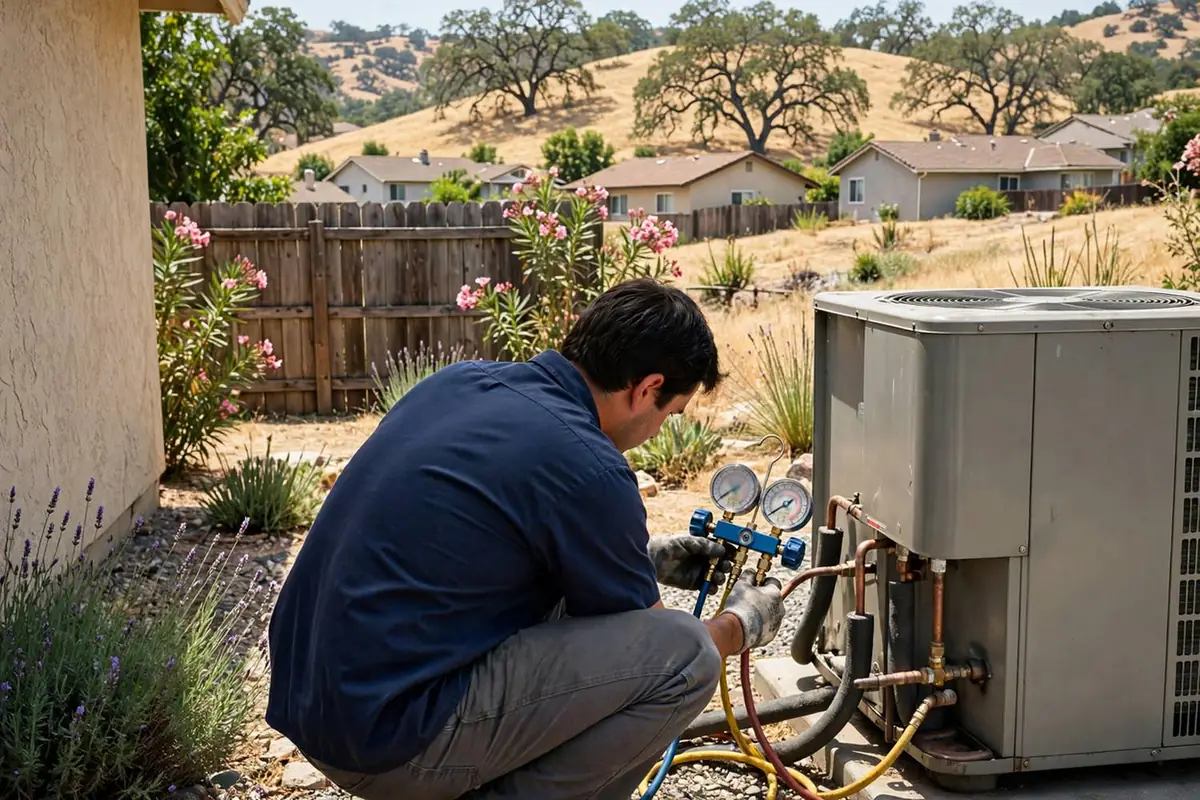
Low refrigerant means there's a leak. Refrigerant doesn't get used up. Low charge drops pressure, the coil gets too cold and may freeze, and a low-pressure switch can cycle the system off and on. You might also notice weak cooling and hissing or bubbling sounds. See signs of a refrigerant leak.
Electrical problems are the other group: a pitted contactor that chatters, a failing control board, loose wiring, or a compressor overheating and tripping its own overload. These need a technician with a meter. After a power outage or a PG&E shutoff, damaged parts can also cause odd cycling, and the power outage guide explains what to check.
What not to do
- Don't keep switching it off and on. Many systems have a built-in delay of a few minutes to protect the compressor. Rapid resets defeat that.
- Don't reset a tripped breaker more than once. If it trips again, leave it off and call.
- Don't open the outdoor unit's electrical panel or touch the capacitor.
- Don't add refrigerant yourself. In the U.S., handling refrigerant requires EPA certification.
- Don't jumper or bypass a float switch or safety switch. It's there to stop damage.
When to call
Call after the basic checks if the system still runs short cycles, if you see ice, hear buzzing outside, smell burning, or the breaker trips. Running a short cycling AC for days can turn a smaller repair into a compressor replacement.
Tell the technician what you saw: how long each run lasted, whether the thermostat kept calling for cooling, and what time of day it gets worse. RD Heat & Air connects Solano County homeowners with participating local HVAC companies for AC repair. Call (707) 418-4772.
Sources
- NOAA NCEI, U.S. Climate Normals 1991–2020 (station files for Vacaville, Nut Tree Airport, Fairfield, Vallejo)
- U.S. Census Bureau, American Community Survey 2020–2024 5-year (tables B25003, B25035, B25040), via Census Reporter
Last reviewed 2026-11-12 by the RD Heat & Air editorial team. Editorial policy.