The short answer: install day vs the whole process
People usually mean one of two things by "how long does it take." How long will crews be in the house? Or how long until this is done, permit and all?
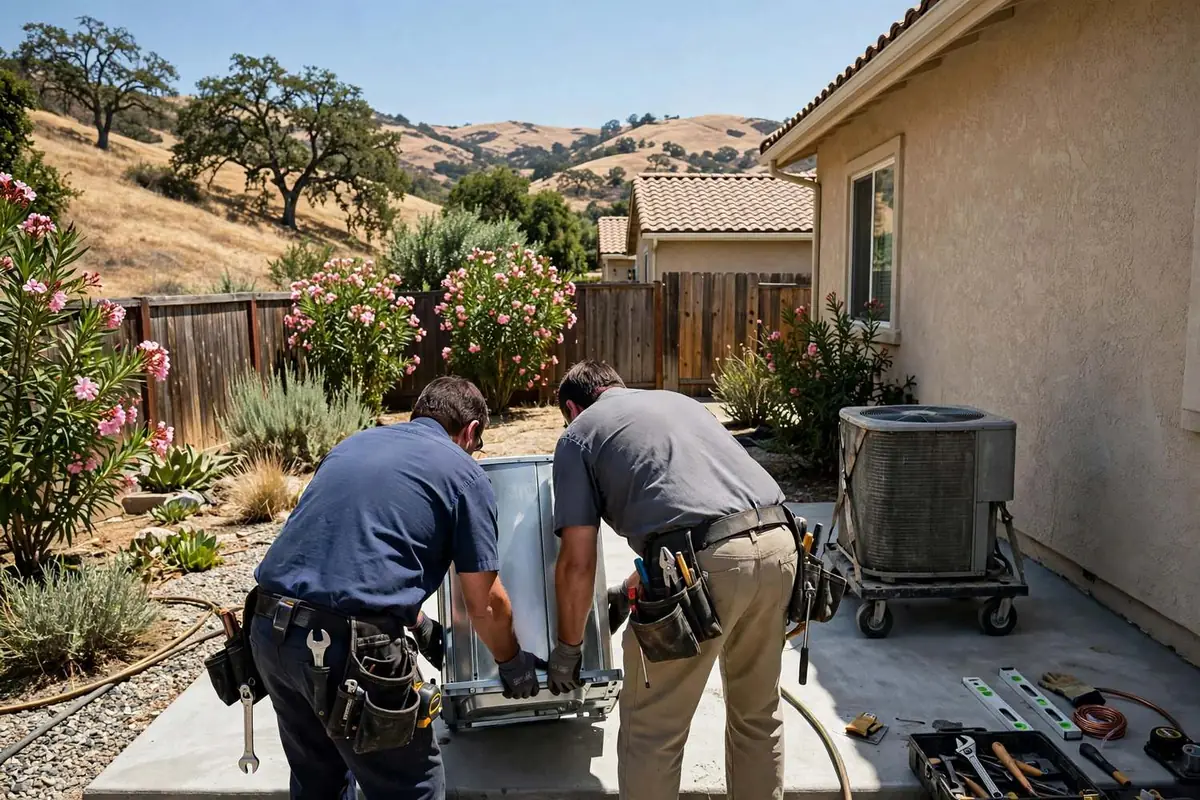
The first is usually short. A crew can often swap a furnace or an outdoor AC unit in a day. The second has more steps, and some of them depend on other people's schedules: the equipment supplier, the city building department and a third-party rater. None of that is unusual. It's just worth planning for, especially if your system has already quit and it's 100°F in Vacaville.
Typical install time by job type
| Job | Usual time on site | What can stretch it |
|---|---|---|
| Furnace only, same location | About a day | Venting changes, attic location, gas line work |
| AC outdoor unit and indoor coil | About a day | New refrigerant lines, pad, electrical disconnect |
| Furnace and AC together | One to two days | Attic installs, duct sealing, return changes |
| Gas furnace and AC to heat pump | Two to three days | Electrical panel or circuit work by an electrician |
| New ductwork with equipment | Adds a day or more | House size, attic or crawlspace access, asbestos found on old ducts |
| Adding central AC to a heat-only home | Two days or more | Duct changes, new circuit, outdoor pad |
These are rough ranges for a typical single-family home. Your installer will give you a real schedule after seeing the house. Ask for it in writing.
Step 1: the estimate and sizing
Before anyone orders equipment, someone should look at the house. A good estimate includes measuring rooms, noting windows and insulation, checking the ducts, and running a load calculation to size the system. Skipping that step is how homes end up with an oversized AC that short cycles or an undersized one that can't keep up in August. How to size an air conditioner explains why a Vacaville home and a Vallejo home of the same size can need different equipment.
Plan on the visit itself taking a while for a full replacement. If you get more than one quote, that adds days. That's time well spent. How to choose an HVAC company has a short list of what to compare, starting with a valid C-20 license you can look up on the CSLB license check.

Step 2: equipment availability
Common furnaces and AC units are often in stock at local suppliers. Less common sizes, high-efficiency variable-speed models, and some heat pumps may need to be ordered. Ask the contractor whether the equipment on your quote is on the shelf.
Refrigerant rules play into this too. Under EPA rules, new residential split AC and heat pump systems installed from January 1, 2025 must use a refrigerant under a lower global-warming limit (EPA HFC restrictions by sector). Most new equipment now uses the replacement refrigerants, and installers have had to adjust stock and tools. If your quote mentions matching a new outdoor unit to an old indoor coil, ask whether the parts are compatible. Refrigerant changes in 2025 explains the change.
Step 3: the building permit
California requires a building permit to install a furnace, AC or heat pump. The California Energy Commission says this applies to any space-conditioning appliance other than a plug-in room unit (CEC HVAC FAQ). The 2025 Energy Code applies to permits applied for on or after January 1, 2026.
The contractor normally pulls the permit. In Solano County that goes through the city:
- Fairfield: Building Safety Division, 1000 Webster Street.
- Vacaville: Building Division at 650 Merchant Street, with online permits through eTRAKiT.
- Vallejo: Central Permit Center at 555 Santa Clara Street, also on eTRAKiT.
- Suisun City, Benicia and Dixon: their city building offices.
- Unincorporated areas: Solano County.
Simple equipment change-outs are often permitted quickly, sometimes online. Bigger jobs with new ducts or electrical work can take longer. The contractor will know the current timing better than anyone. More detail is in Title 24 HVAC permits.
Step 4: install day
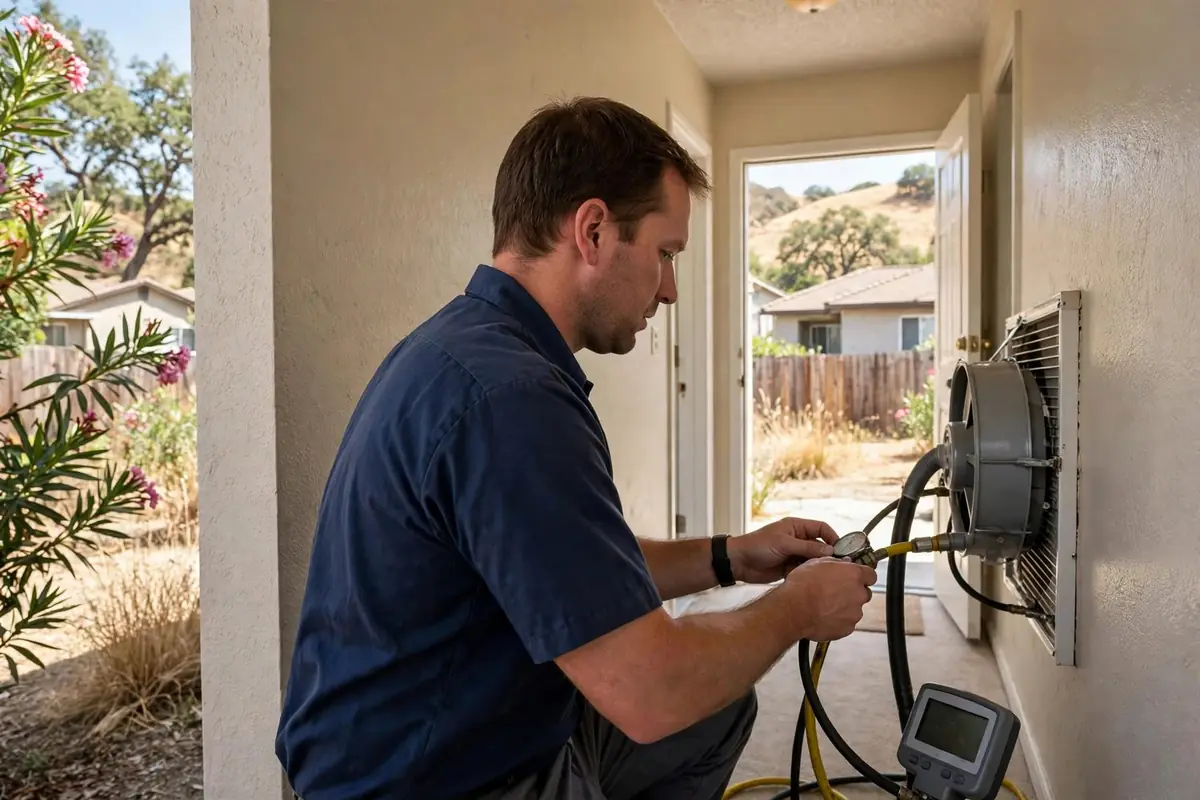
On a typical replacement day, the crew protects floors, shuts off gas and power to the equipment, and recovers the old refrigerant. That last step has to be done by a technician certified under EPA Section 608, which the CEC notes in its HVAC guidance. Then the old equipment comes out and the new equipment goes in, with any venting, refrigerant line, electrical and duct changes. Duct sealing happens now too, since the Energy Code requires it on most replacements.
Before the crew leaves, the system should be started up and tested in heating and, if the weather allows, cooling. Ask for a quick walk-through: the thermostat, the filter location and size, and where the disconnects are.
Help the day go faster:
- Clear a path from the door to the furnace, attic hatch and outdoor unit.
- Move cars out of the garage if the furnace is there.
- Keep pets in a closed room or out of the house. Doors will be open a lot.
- Pull stored boxes away from the attic hatch and furnace closet.
- Have someone home who can make decisions if the crew finds a surprise.
Step 5: ECC-Rater testing
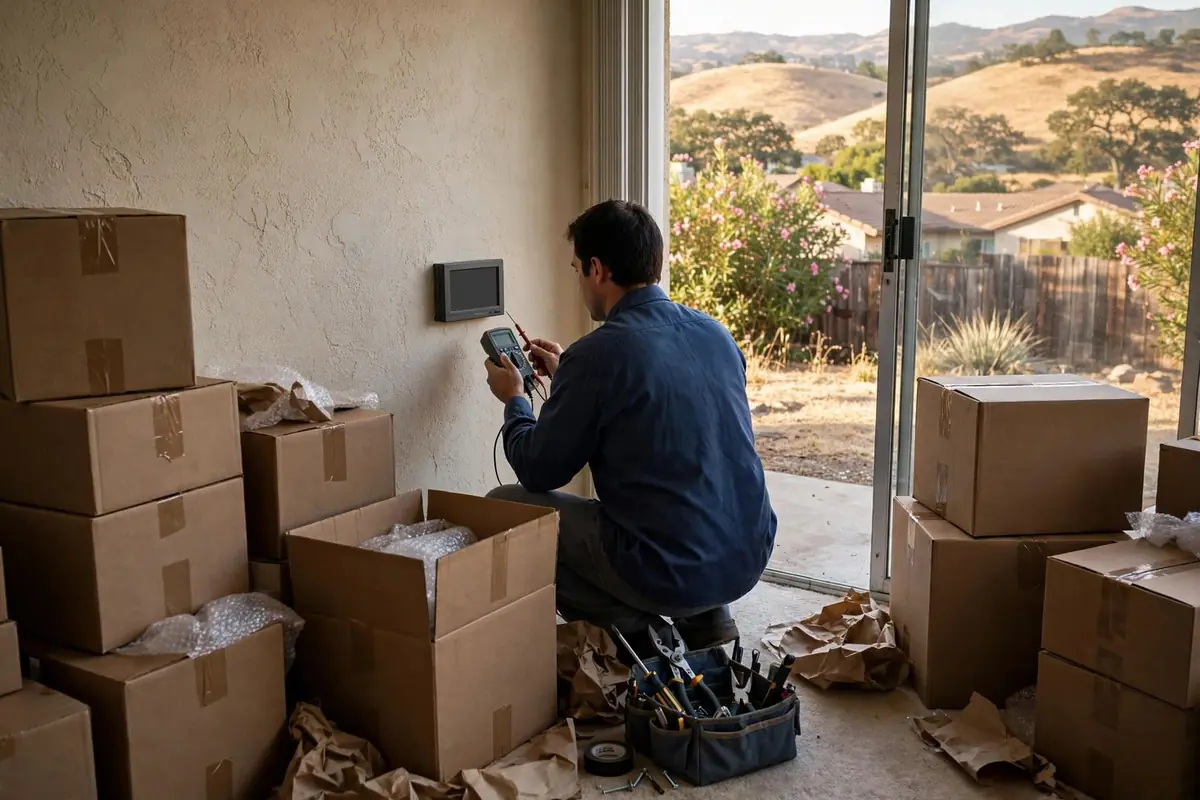
California's Energy Code requires third-party field verification on most HVAC replacements. That person used to be called a HERS Rater and is now called an ECC-Rater, under the state's Energy Code Compliance program.
Depending on the job, the rater may test:
- Duct leakage gets tested on most jobs. Under the 2025 code, the CEC says existing ducts must test at no more than 10% total leakage or 7% leakage to outside. If they can't get there after sealing, the rater may verify with a smoke test and visual inspection.
- Refrigerant charge is verified for heat pumps in all climate zones, and for air conditioners in several zones including climate zone 12, where most of Solano County sits.
- Some jobs also need other checks, such as airflow or fan efficiency.
Some contractors coordinate the rater on install day. Others schedule the rater a few days later. If the ducts fail, the crew comes back to seal more and the rater retests. That's the single most common reason a "one-day job" isn't fully closed out for a week or two. Old attic ducts in 1980s homes, common in Fairfield and Vacaville, are the usual suspect. See leaky attic ductwork.
Step 6: the city's final inspection
After the rater's paperwork is filed, the city building inspector does a final inspection. The inspector checks things like gas connections, venting, clearances, electrical, and that the equipment matches the permit. Someone usually needs to be home to let them in.
When it passes, the permit is "finaled." Keep a copy of the finaled permit, the rater's certificate and the equipment model and serial numbers together. You'll want them for warranty registration (see HVAC warranties explained) and when you sell the home.
What slows a replacement down?
- Switching to a heat pump can mean new circuits or a larger panel. That's a separate trade and sometimes a PG&E coordination.
- Crews take breaks in a hot attic for safety. A July attic install in Dixon or Vacaville can run longer than the same job in March.
- Older homes hide surprises: asbestos on old ducts, a corroded gas line, or a vent that doesn't meet current rules.
- Some rebate programs only pay if you're approved before installation. TECH Clean California's single-family heat pump funds were fully reserved statewide in February 2026, and waitlisted projects qualify only if installed after approval (TECH Clean California). Check before you schedule. Heat pump rebates in 2026 has the current picture.
- Some neighborhoods need HOA approval for a new outdoor unit location.
- If you're using financing, approval adds a step.
What if the system died in a heat wave?
That's when timelines feel longest. Ask the contractor whether a repair can get you through while the replacement is arranged. Sometimes a capacitor or motor buys you a few weeks. If not, ask how soon they can install and what the permit timing looks like.
In the meantime, keep the house as cool as you can: blinds closed, fans on, cooking outside or not at all, and a plan for anyone who's vulnerable to heat. The heat-wave AC plan covers what to do. Furnace out in winter? Use space heaters carefully and keep them away from anything that burns.
When you're ready to get started, call (707) 418-4772. The line connects you with participating local HVAC companies that do furnace, AC, heat pump and boiler replacements in Solano County.
Sources
- California Energy Commission, Energy Code Support Center: HVAC FAQ
- California Energy Commission, 2025 Energy Code overview
- U.S. EPA, Technology Transitions: HFC restrictions by sector
- TECH Clean California, Incentives
- Contractors State License Board, Check a License
- City of Vacaville, Building Division
- City of Fairfield, Building Safety Division
Last reviewed 2026-11-12 by the RD Heat & Air editorial team. Editorial policy.