What kinds of HVAC warranties are there?
There are usually up to four, and people mix them up constantly.
| Type | Who provides it | What it usually covers |
|---|---|---|
| Manufacturer's limited warranty | The equipment brand | Replacement parts that fail from defects; sometimes longer terms on compressors and heat exchangers |
| Labor (workmanship) warranty | The contractor who installed it | Their labor to fix installation problems, and sometimes labor on warranty part swaps |
| Extended service plan | Manufacturer, contractor or third party, sold separately | Extra labor or parts coverage past the standard terms |
| Home warranty | A home warranty company | A service contract on many home systems, with its own limits, fees and approved contractors |
A maintenance plan is something different again. It pays for checkups, not repairs. See HVAC maintenance plans explained.
What does a manufacturer's warranty actually cover?
Parts. Mostly just parts. If the inducer motor in your furnace fails in year four from a defect, the manufacturer's warranty typically supplies a replacement motor. The technician's time to diagnose the failure and install the part is often not included. Refrigerant used during a repair is also often excluded.
That surprises a lot of people. You can be "under warranty" and still get a bill for the visit and the labor. Read the warranty document for your model before something breaks so you know which parts of a repair it pays for.
A few details to look for in yours:
- Separate terms for the compressor (AC and heat pumps) or heat exchanger (furnaces).
- Whether coverage is for the original owner only, or transfers if you sell.
- Exclusions for improper installation, lack of maintenance, or damage from power surges, floods or fire.
- What the company will do: repair, replace the part, or something else.
Do you have to register your HVAC system in California?
Often not, and this is one of the more useful things to know as a California homeowner. Many brands give a short base warranty automatically and a longer one if you register online within about 60 days of installation. But several manufacturers exempt California.
Lennox, for example, says its extended limited warranty requires registration within 60 days after installation, except in California and Quebec. Daikin says the same online registration isn't required in California, Florida or Quebec. Other brands have similar language, and the exempt states vary by brand and install date.
Even so, register anyway. It costs a few minutes, it puts the install date on record with the manufacturer, and it helps if you sell the house or lose your paperwork. Write down the model and serial numbers of the furnace or air handler, the outdoor unit and the indoor coil before you do.
What does the installer's labor warranty cover?
This is the contractor's own promise, so it varies a lot. Some cover their workmanship for a year. Some cover longer, or include labor on warranty part replacements for a set time. A few offer very little.
Get it in writing as part of the contract. California requires home improvement contracts to be in writing, and the CSLB has guidance on what they should contain. Ask these questions before you sign:
- How long is the labor warranty, and does it cover labor on manufacturer part failures?
- Does it cover refrigerant leaks at the connections the installer made?
- Is it transferable if you sell?
- Does it require a yearly maintenance visit to stay valid?
- Who registers the equipment with the manufacturer, you or them?
Labor warranties are only as good as the company behind them. Check the license with the CSLB license lookup (HVAC is the C-20 class) and read how to choose an HVAC company.
Can a manufacturer make you use their service to keep the warranty?
Generally not. According to the Federal Trade Commission, federal law generally keeps a manufacturer from requiring specific brand-name parts or services to keep warranty coverage, unless it provides them at no charge or has an FTC waiver. In practice that means a licensed local company can usually maintain your system without voiding the warranty.
That said, the warranty can still exclude damage caused by bad work. If a repair goes wrong and damages the system, the manufacturer may decline that claim. Pick a licensed company and keep the receipts.
The FTC also points out that state law gives you implied warranties on most purchases, and that extended warranties sold separately can duplicate coverage you already have. Read both before you buy one.
What does permitting have to do with your warranty?
More than you'd think. In California, installing a new furnace, AC or heat pump requires a building permit under the Energy Code, and many change-outs need duct testing and third-party verification by an ECC-Rater. The 2025 version of the code applies to permit applications submitted on or after January 1, 2026. Details are on the Title 24 permits page.
A permitted, inspected install gives you a paper trail: the install date, the equipment and a final inspection. That record helps with warranty claims and when you sell. If a contractor suggests skipping the permit, that's a red flag about the rest of the job too.

Buying a used home? Check the warranty status
Median home build years in these Solano cities run from 1975 in Vallejo to 1988 in Dixon (ACS 2020-2024), so many homes for sale have had at least one system replacement. Ask the seller for:
- Install date and the contractor's name
- The permit number or final inspection record
- Model and serial numbers of each piece of equipment
- Any registration confirmation or warranty certificate
- Maintenance receipts
Some extended coverage only applies to the original owner, and some transfers with a form or fee. If there are no records, the manufacturer can sometimes look up coverage by serial number. Families relocating to Travis AFB buy and sell homes on short timelines, and having this folder ready makes the inspection go smoother. The Travis AFB HVAC tips has more for military movers.
What to do when a system under warranty breaks
- Do the safe checks first: thermostat, breaker, filter, the outdoor disconnect. Many "broken" systems are a tripped breaker after a heat wave or an outage.
- Find your paperwork: install date, model and serial numbers, installer's name.
- If the install is recent, call the installing contractor first, since their labor warranty may apply.
- Ask the technician to tell you before the work starts which parts the manufacturer covers and what labor and refrigerant will cost.
- Keep the invoice. It should show the failed part, the replacement part's numbers and the date.
If you smell gas, skip the list. Leave the house and call 9-1-1 and PG&E at 1-800-743-5000 from outside. See burning or gas smell.
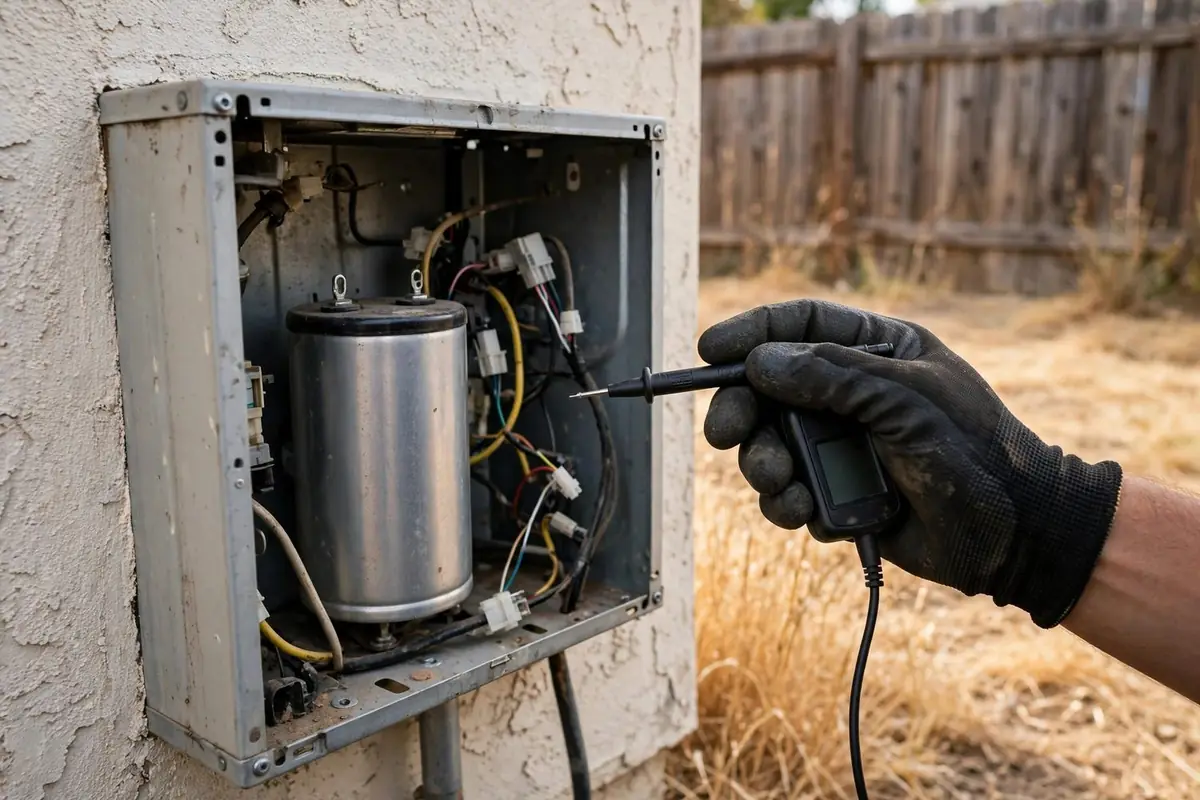
Heat waves are when warranty questions come up most. Vacaville's downtown station averages about 28 days a year at 100°F or hotter, and parts like capacitors and fan motors tend to fail when the system works hardest. If your AC quits on one of those days, the heat wave AC plan covers what to do while you wait.
The short checklist
Keep one folder (paper or a phone photo album) with the contract, permit, model and serial numbers, registration confirmation and every service receipt. Register online even if California doesn't require it. Know who you call first: the installer for recent jobs, any licensed company after that. If you need a technician now, call (707) 418-4772 to reach a participating local HVAC company. Warranty terms are set by the manufacturer and the installer, not by RD Heat & Air.
Sources
- Contractors State License Board, C-20 Warm-Air Heating, Ventilating and Air-Conditioning classification
- Contractors State License Board, Check a License
- California Energy Commission, Energy Code Support Center: HVAC FAQ
- California Energy Commission, 2025 Energy Code overview
- U.S. Census Bureau, American Community Survey 2020–2024 5-year (tables B25003, B25035, B25040), via Census Reporter
- NOAA NCEI, U.S. Climate Normals 1991–2020 (station files for Vacaville, Nut Tree Airport, Fairfield, Vallejo)
- FTC consumer advice: hiring a contractor
Last reviewed 2026-11-12 by the RD Heat & Air editorial team. Editorial policy.