What does an AC capacitor do?
Your outdoor AC unit has two big motors: the compressor, which pumps refrigerant, and the fan motor on top, which pulls air through the coil. Neither one can start smoothly on household power alone. The capacitor gives them a timed boost of electrical energy that gets them turning in the right direction and keeps them running efficiently.
Think of it like a push on a merry-go-round. The motor could eventually get going without it, but it would strain, overheat and draw far too much current. With a healthy capacitor, it starts cleanly in a second or two.
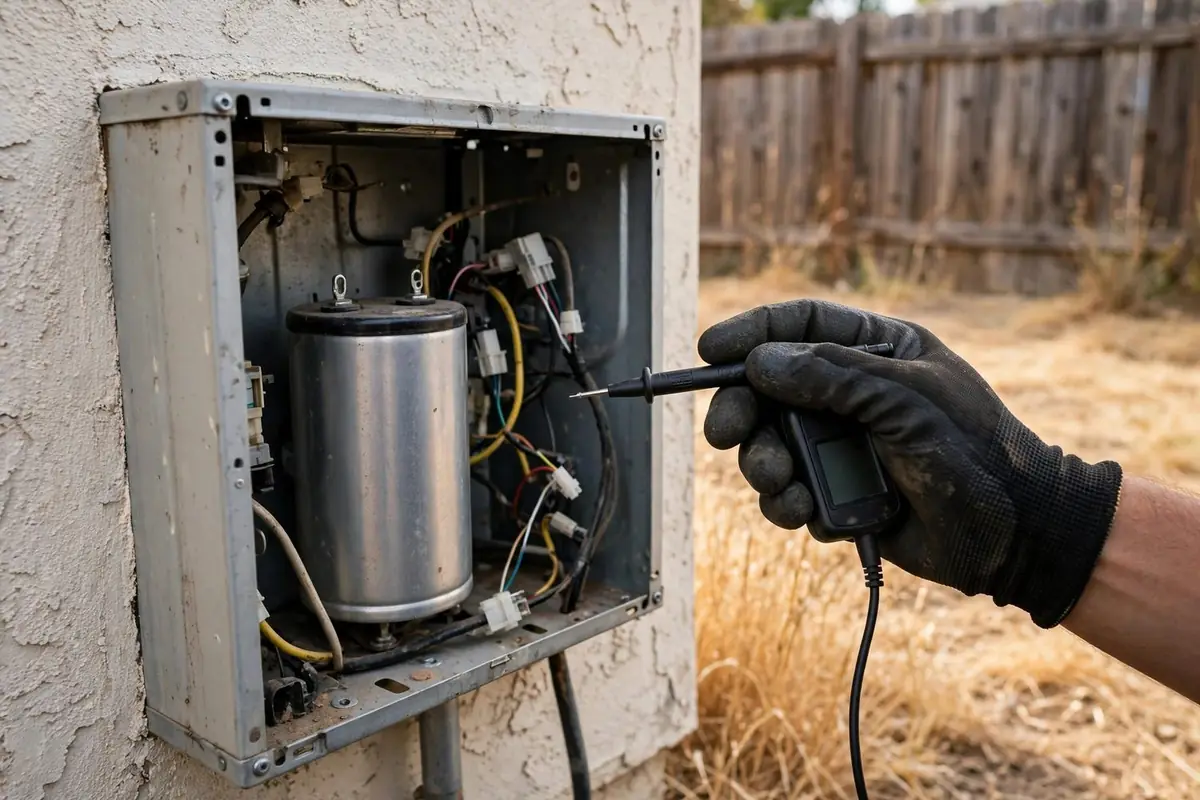
The capacitor itself is a sealed can, usually silver, about the size of a soda can or smaller, mounted inside the electrical panel of the outdoor unit. You can't see it without removing a service panel, and you shouldn't.
What kinds of capacitors are in an AC?
Most residential systems have one or more of these:
| Type | What it does | Notes |
|---|---|---|
| Dual run capacitor | Runs both the compressor and the outdoor fan motor | Most common in split AC and heat pump systems; has three terminals |
| Single run capacitor | Runs one motor | Some units have separate ones for fan and compressor |
| Start capacitor (hard-start kit) | Gives the compressor an extra kick at startup, then drops out | Often added to older compressors that struggle to start |
| Blower motor capacitor | Runs the indoor blower on some furnaces and air handlers | Not in every system; many newer blowers don't use one |
Each capacitor is rated in microfarads (shown as µF or MFD) and for a maximum voltage. A replacement has to match the motor's specifications. Bigger isn't better here; the wrong rating can make a motor run hot.
Why do capacitors fail in heat waves?
Heat is the main enemy. A capacitor slowly loses capacity as it ages, and high temperatures speed that up. The capacitor sits inside a metal cabinet in direct sun, right next to a compressor that's running hot, on the hottest days of the year.
Inland Solano County gives capacitors a rough life. NOAA's 1991–2020 climate normals show downtown Vacaville averaging about 28 days a year at 100°F or hotter and about 101 days at 90°F or more. Fairfield averages about 11 days at 100°F and 60 days at 90°F. During the September 2022 heat wave, NOAA stations in Fairfield and Vacaville recorded highs around 114 to 115°F.
Long heat waves are especially hard because the AC runs nearly nonstop. A capacitor that was already weak in June often makes it through a few mild weeks, then finally quits on the third or fourth 105°F afternoon. That's why "AC humming but not running" calls spike right when everyone needs cooling most.
The Delta breeze helps closer to the water. Vallejo averages about 7 days a year at 100°F or more. When the breeze stalls, though, the whole I-80 corridor bakes. See the Delta breeze and your AC.

What are the signs of a bad AC capacitor?
Most capacitor failures show up as the outdoor unit not starting right. Common signs:
- The outdoor unit hums, but the fan on top doesn't spin.
- The fan spins, but you don't hear the compressor kick on, and the air inside isn't getting cold.
- The unit takes several seconds of buzzing before it starts.
- The AC starts, runs briefly, then shuts off, and the breaker may trip.
- Lights dim noticeably when the AC starts.
- The indoor blower runs but the house slowly warms up.
A technician may also find a bulging or leaking top on the capacitor can. That's a sure sign it's done, but only a tech should be opening the panel to see it.
Plenty of other parts can cause the same symptoms, including the contactor, the fan motor, or a compressor that's failing. That's why a tech tests rather than guesses. For a step-by-step on a silent or humming condenser, see outside AC unit not running.
What should you do if you think the capacitor failed?
Act quickly, because a compressor that keeps trying to start without help overheats and can be damaged.
- Turn the system to Off at the thermostat.
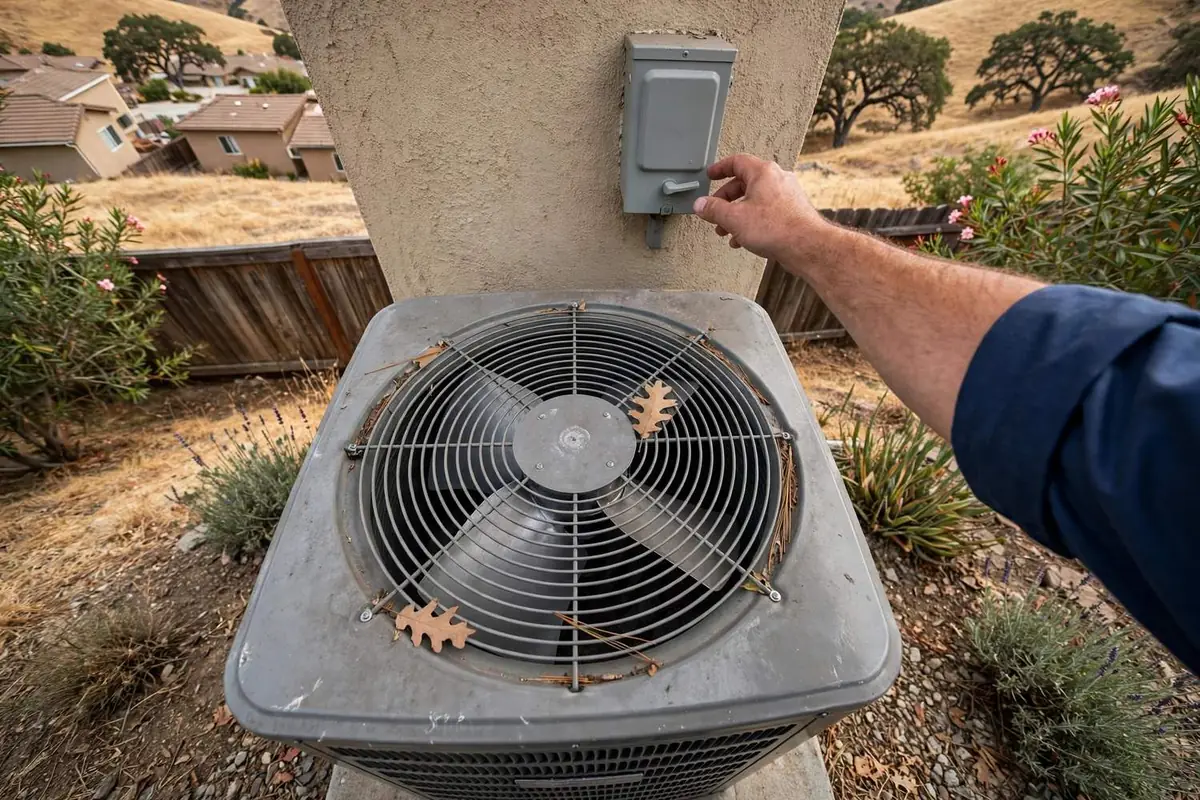
- Look at the outdoor unit from a safe distance. Is the fan still? Is it humming? That's useful information for the tech.
- Check the breaker. If it tripped, you can reset it once. If it trips again, leave it off.
- Clear debris, toys or plants from around the unit so there's room for the tech to work.
- Call for service and say "humming, fan not spinning" or whatever you noticed.
On a dangerous-heat day, plan for the wait. Close blinds on sunny windows, use fans, and if anyone in the house is elderly, very young or has a health condition, go somewhere cool. The heat wave AC plan lists practical steps, and emergency HVAC explains when a no-cooling situation is urgent.
Why you shouldn't replace a capacitor yourself
You'll find videos showing people swapping capacitors in ten minutes. Some of those people know what they're doing. Many don't, and the risk isn't small.
- A capacitor can hold a dangerous electrical charge even after the power is off. Discharging and testing it takes the right tools and training.
- The outdoor panel has high-voltage wiring right next to the capacitor.
- Installing the wrong rating, or wiring a dual capacitor's terminals wrong, can burn out the fan motor or compressor. Those are much bigger repairs.
- A failed capacitor is sometimes a symptom. A failing fan motor or a compressor that's drawing too much current can kill a new capacitor quickly.
And please don't follow the advice to poke the fan blades with a stick to get them spinning. It puts your hand near moving blades and live parts, and it does nothing about why the fan didn't start.
Leave the panel closed. This is one of the most routine summer repairs a technician does.

What will a technician check?
A good technician does more than swap the can:
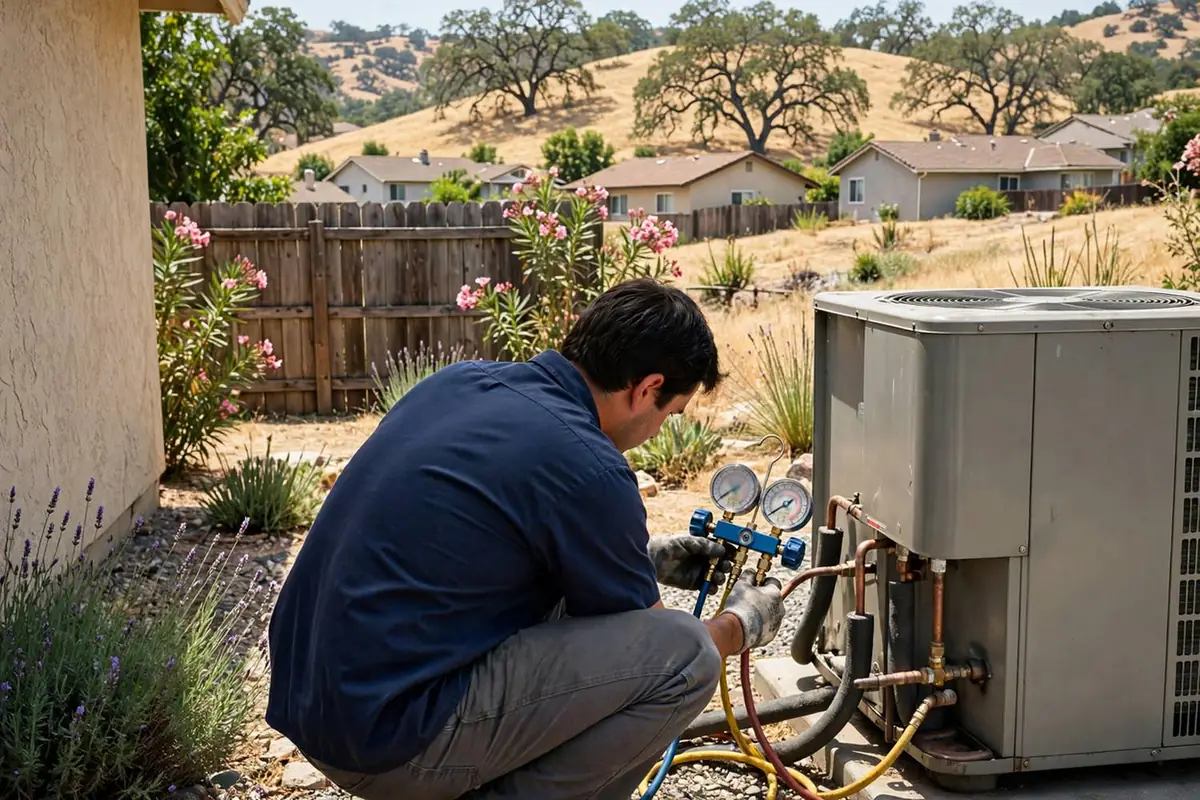
- Shuts off and locks out power, then safely discharges the capacitor.
- Measures the capacitor's actual microfarads with a meter and compares it to the rating on the label.
- Checks the contactor, wiring and terminals for burn marks or loose connections.
- Tests the fan motor and the compressor's current draw after replacement.
- Confirms the outdoor fan and compressor start promptly and the system is cooling.
- Looks at the condenser coil, since a dirty coil makes everything run hotter.
Ask the tech what they measured and why the part failed. If the answer is "it was just old and hot," fine. If they mention a motor drawing high amps or a compressor that's hard-starting, ask what that means for the system's remaining life.
Can you make a capacitor last longer?
You can't control the weather, but you can cut down on the stress:
- Keep a couple of feet clear around the outdoor unit. Shrubs, fences and stored items trap hot air.
- Keep the coil clean. Valley dust, grass seed and cottonwood fluff pack the fins on many Vacaville and Dixon units. With the power off at the disconnect, a gentle hose rinse helps; no pressure washer.
- Change the indoor filter on schedule. Poor airflow makes the whole system work harder.
- Have the capacitor measured during a spring tune-up. A weak one can be replaced before it fails in July. See what a real AC tune-up includes.
- Avoid short, frequent on-off cycles. Big swings on the thermostat during a heat wave don't help.
Power events matter too. Outages and surges can damage capacitors and control boards. After a PG&E outage or a Public Safety Power Shutoff, see power outages and HVAC for restart tips.
Is a bad capacitor a reason to replace the AC?
Almost never by itself. A capacitor is a wear part, a bit like a car battery. Replacing it is a standard repair on a system of any age.
What can change the picture is what else the tech finds. If the compressor is struggling, refrigerant is low from a leak, or the system is old and uses a refrigerant that's being phased out, the capacitor call can turn into a repair-or-replace conversation. For older systems, see repair or replace a 15-year-old AC and refrigerant changes. The cost factors guide explains what affects a repair bill without quoting prices.
When to call
If your outdoor unit is humming without the fan spinning, slow to start, or shutting off, turn the system off and call. The sooner the compressor stops straining, the better.
RD Heat & Air connects callers in Fairfield, Vacaville, Suisun City, Benicia, Dixon and Vallejo with participating local AC companies. Call (707) 418-4772. For more on AC service in your area, see AC repair, Vacaville AC repair or Fairfield air conditioning.
Sources
- NOAA NCEI, U.S. Climate Normals 1991–2020 (station files for Vacaville, Nut Tree Airport, Fairfield, Vallejo)
- NOAA NCEI, Global Historical Climatology Network daily records
- National Weather Service, Technical Attachment 95-21: the Delta breeze
Last reviewed 2026-11-12 by the RD Heat & Air editorial team. Editorial policy.